Permit to Work · Knowledge Hub · Page 1 of 10
Permit to Work History and Evolution
From the mines and refineries of the early twentieth century to Piper Alpha and HSG250 – how modern permit to work systems emerged from industrial catastrophe.
Verification · Coordination · Control
- Why the history matters
- Early industrial origins
- The oil and gas sector and the growth of permit systems
- Complexity, maintenance and shutdowns
- The disasters that shaped permit to work
- Regulation and the development of modern guidance
- From paper to system: the evolution of modern PTW
- Summary: why PTW exists
- Frequently Asked Questions
Why the History Matters
It is tempting to view a permit to work as an administrative routine a form to be filled in, signed and filed. Many workers encounter PTW in exactly that way: as procedure rather than purpose. This framing does permit systems a serious disservice, and it creates a real practical problem. Workers who do not understand why a system exists are far less likely to apply it with the care and rigour it demands.
The history of permit to work is a history of catastrophic failures in the management of hazardous work. It is a history of explosions, fires and deaths that occurred not because the hazards were unknown, but because the systems and disciplines to control them were absent or inadequately applied. Understanding that history transforms the permit from a piece of paper into what it actually is: a safety-critical communication and control system.

Early Industrial Origins
The roots and history of permit to work lie in heavy industry of the late nineteenth and early twentieth centuries: coal mines, iron and steel plants, chemical works, and the early oil refineries. These were environments where workers regularly encountered hazards that were invisible, unpredictable, and lethal gases, steam under pressure, machinery that could start without warning, and confined spaces where a single mistake could kill a man before he had time to react.
The early responses to these hazards were informal. Verbal instructions passed between foremen and gangs. Chalk marks on equipment. Simple lock-out arrangements where a worker placed his own padlock on an energy source. These approaches worked, in part, for small workforces undertaking relatively simple tasks in predictable environments. They were wholly inadequate for the increasingly complex operations that industrial expansion demanded.
As plant size grew, as the number of workers operating on the same equipment at the same time increased, and as the energy sources being controlled became more powerful, the limitations of informal verbal control became apparent. A foreman who had isolated a piece of machinery for maintenance could not always know that a second crew, acting on different instructions from a different supervisor, was about to re-energise it. Communication between departments was poor. No one held an authoritative picture of who was working on what.
The mining industry
What is significant to the history of permit to work, is that coal mining developed some of the earliest formal authorisation systems, driven by the particular hazards of underground work: firedamp (methane), blackdamp (oxygen-depleted air), roof falls, and the catastrophic consequences of igniting accumulated gas. Safety legislation from the mid-Victorian period onward imposed testing requirements and basic management disciplines, but formal written authorisation systems for maintenance work developed more slowly, often following specific disasters in individual collieries.
Chemical and refinery origins
The chemical industry had a major role to play in history of permit to work, and the early petroleum refining sector, began developing more structured approaches to hazardous work authorisation during the first decades of the twentieth century. The presence of flammable and toxic substances under pressure created conditions where informal control was clearly inadequate. Permits for hot work any activity involving heat, flame, or spark in an area containing flammable materials were among the earliest formalised permit types, appearing in some American and British refineries from the 1920s onward.
The Oil and Gas Sector and the Growth of Permit Systems
If the first half of the twentieth century saw the seeds of permit to work planted in heavy industry, the post-war expansion of the oil and gas sector provided the conditions in which formal permit systems grew rapidly. The 1950s, 1960s and 1970s saw a dramatic expansion in refinery capacity, the development of petrochemical complexes of unprecedented scale, and, crucially, the beginning of offshore oil and gas production.
These new environments shared several characteristics that made structured hazardous work control an operational necessity. They were large, complex and interdependent: a single large refinery might have dozens of separate processes, all potentially affecting one another. They contained enormous inventories of flammable, toxic, and high-pressure materials. They operated continuously, meaning that maintenance work had to be carried out on live plant or on plant that had just been taken offline and might be returned to service rather than during extended shutdowns of the entire facility.
The major oil companies Shell, BP, Esso, and others began developing group-wide standards for hazardous work control during this period. These early corporate standards were not uniform in their requirements, but they shared a common structure: written authorisation from a responsible person before hazardous work could begin; identification of specific hazards; specification of precautions required; and a mechanism for confirming that precautions had been taken.
As North Sea oil production expanded from the late 1960s, the offshore sector drove significant development in permit to work practice. The confined geography of offshore platforms, the absence of any escape route that did not involve the sea, and the co-location of hydrocarbon processing with accommodation made the consequences of poorly controlled work uniquely severe. Permit systems on offshore installations developed accordingly, though as later events would demonstrate, development was uneven and often inadequate.
Complexity, Maintenance and Shutdowns
The growth in industrial complexity through the latter half of the twentieth century continuously raised the demands placed on hazardous work control systems. As plant became more sophisticated, the number of people involved in any single maintenance task multiplied. A significant job on a process vessel might require mechanical fitters, pipefitters, electricians, instrument technicians, scaffolders, and insulation workers to be present and working in the same area, often simultaneously or in close sequence.
This created a problem that simple verbal authorisation had never been designed to address: how do you maintain safe working conditions when the task is inherently multi-disciplinary, when different trades report to different supervisors, when the work spans multiple shifts, and when the underlying plant configuration may change as the job progresses?
Plant shutdowns and turnarounds
The periodic major maintenance shutdown known in industry as a turnaround or TAR placed particular pressure on permit systems. During a shutdown, the normal operational logic of a plant is suspended. Equipment is offline, isolated, opened up, and exposed. Hundreds of contractors may be working alongside permanent staff. The tempo is intense, the pressure to return plant to service is considerable, and the hazards are, if anything, greater than during normal operation precisely because plant is open and abnormal.
Managing the issue and control of hundreds of permits simultaneously, ensuring that isolations remain intact, that permit conditions do not conflict with one another, and that work is properly closed out before equipment is returned to service these are significant management challenges. The failure to meet them has been a contributing factor in numerous serious incidents during shutdown operations.
The interface problem
One of the most persistent hazards in complex industrial operations is the interface between different work activities. Work taking place on one item of plant can create hazards for a separate work party on adjacent plant. A permit system that treats each task in isolation, without considering how permits interact with one another, provides only partial control. Recognising and managing these interfaces became an important driver in the development of more sophisticated permit systems.
The Disasters That Shaped Permit to Work – Lessons Written in Blood
The development of permit to work was not driven solely by regulation, guidance, or evolving management practice. It was also shaped by major industrial accidents that exposed weaknesses in how hazardous work was planned, authorised, communicated and controlled.
The hazards themselves were rarely new. What failed, repeatedly, was the discipline to control them. Maintenance, temporary modifications, contractor activity, equipment isolation and shift handovers each introduced risks that informal arrangements could not manage, and each, as the incidents below show, has a catastrophe attached to it.
The controls written into a modern permit system are not arbitrary. The three incidents that follow are among the most significant examples of where their absence proved fatal, and each continues to shape permit to work practice today.
-
1974
1 June 1974 · Flixborough, England
Flixborough
The permit failureA temporary bypass pipe installed with no formal engineering review or change authorisation.
A modified reactor line failed and released roughly 40 tonnes of cyclohexane. The resulting vapour cloud explosion levelled most of the site and damaged property for miles.
28 killed · 89 injured · all 18 in the control room died
-
1988
6 July 1988 · North Sea, off Aberdeen
Piper Alpha
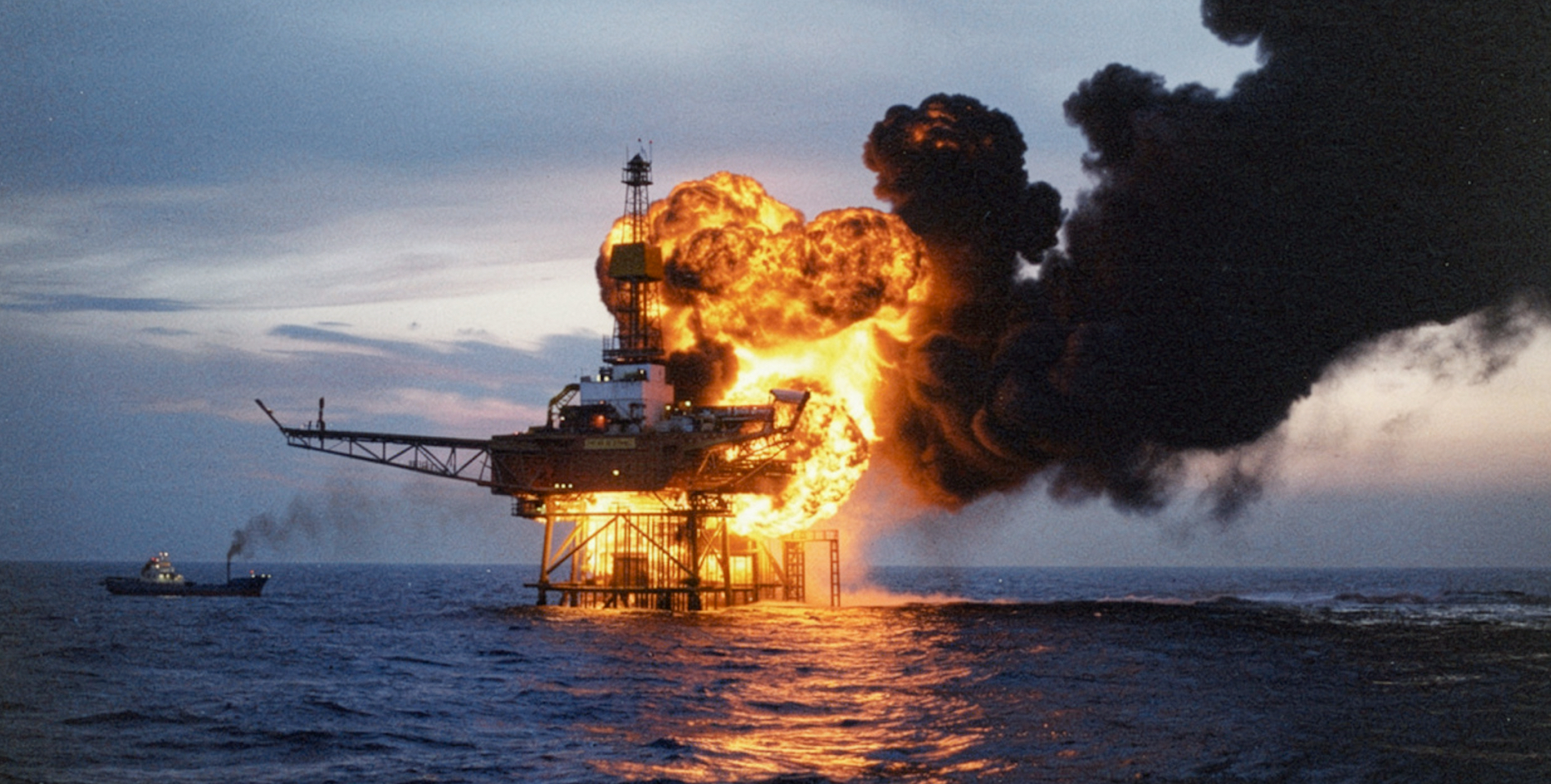
The permit failureA pump restarted with its safety valve removed – the permit was not in its place and the shift handover failed.
An initial gas release and explosion escalated into the deadliest offshore oil disaster in history.
167 killed · only 61 survived
-
2005
23 March 2005 · Texas City, USA
Texas City Refinery
The permit failureA unit restarted after a deficient pre-startup safety review, with non-essential staff inside the blast zone.
A raffinate splitter tower overfilled; the blowdown system was overwhelmed and the released vapour ignited.
15 killed · 180 injured · over $1.5bn damage
These three events represent only a fraction of the incidents that have shaped the history of permit to work. Numerous other fires, explosions, toxic releases and confined space fatalities many less well-known than Piper Alpha but equally instructive have contributed to the layered understanding of where permit systems fail and what effective permit practice requires.
Further reading 0 – primary sources: Flixborough (1974) – HSE · Piper Alpha (1988) – The Cullen Report (IChemE, free download) · Texas City (2005) – U.S. Chemical Safety Board
Regulation and the Development of Modern Guidance
The regulatory framework for permit to work in Great Britain and across much of the world did not arrive fully formed. It developed incrementally, shaped by disaster, inquiry, and an evolving understanding of how formal safety management systems translate into practice on the ground.
-
1972
The Robens Report
Lord Robens’ Committee of Inquiry on industrial safety produced a landmark report arguing that the existing fragmented legislative framework was inadequate and that responsibility for safety must be shared between employers and workers. This report directly produced the Health and Safety at Work etc. Act 1974, which established the modern framework of self-regulation backed by goal-setting legislation — within which formal work control systems operate.
-
1974
Health and Safety at Work etc. Act
The HSWA established general duties for employers to ensure, so far as is reasonably practicable, the health, safety and welfare of employees and others affected by their work activities. While not prescribing permit to work specifically, it created the legislative basis under which the absence of adequate hazardous work control can constitute a criminal failure of duty.
-
1989
Electricity at Work Regulations
These regulations, which came into force in 1990, placed formal requirements on the management of electrical systems and specifically contemplated permit to work as a means of satisfying the duty to prevent danger from electrical work. They remain a key reference for electrical permit systems.
-
1992
Offshore Installations (Safety Case) Regulations
Arising directly from the Cullen Report into Piper Alpha, these regulations required offshore operators to produce safety cases demonstrating the adequacy of their safety management systems. Permit to work featured prominently as a safety-critical system that required formal management and verification. Successive revisions of the offshore safety case regime have continued to emphasise the centrality of PTW.
-
1999
Management of Health and Safety at Work Regulations
These regulations reinforced requirements for risk assessment and the implementation of appropriate control measures. The requirement for planned and systematic management of risks, particularly during non-routine work such as maintenance and modification, provides the regulatory context in which formal permit systems operate.
-
2005
HSE Guidance HSG250: Permit to Work Systems
The Health and Safety Executive published HSG250 as a dedicated, comprehensive guidance document for permit to work systems. This guidance remains the primary reference for PTW practice in Great Britain. It defines what a permit to work is, explains the circumstances in which one is required, describes the essential elements of a permit system, and provides guidance on design, implementation, and audit.
-
→
Industry Standards and International Development
Alongside regulatory development, major industry bodies and companies have developed their own standards and guidance for PTW. The Energy Institute, the International Association of Oil and Gas Producers (IOGP), and national and international standards bodies have all contributed to a growing body of best practice guidance. Many major oil companies maintain group-wide PTW standards that, in some respects, exceed regulatory minimums.
From Paper to System: The Evolution of Modern PTW
The earliest permit to work documents were simple: a brief written statement that work had been authorised, perhaps specifying the precautions required. They were paper documents, often hand-written, often single-page. In many respects they were an improvement on verbal instruction they created a record, they required someone to sign, and they communicated key information in writing. But they were not systems in any meaningful sense.
The modern permit to work is something considerably more sophisticated. The document itself whether paper or, increasingly, electronic is merely the visible element of a management system that encompasses written procedures for permit design and issue; training and competency requirements for all involved parties; formal isolation and verification procedures; arrangements for managing concurrent work and permit interactions; shift handover protocols; close-out and returning-to-service procedures; audit and performance monitoring; and clear accountability at every stage.
Core elements of a modern PTW system, per HSG250
HSG250 highlights that a permit-to-work system depends on clear procedures, competent people, strong communication, verified isolations and active review throughout the permit lifecycle.
Written procedures
Documented procedures covering every aspect of the permit cycle, from design through issue to close-out.
Isolation & verification
Formal identification, application and independent verification of all energy isolations required for safe working.
Communication
Mechanisms for ensuring all parties, including operations, maintenance and contractors, share the same understanding of permit conditions.
Concurrent work management
Systems for identifying and managing interactions between simultaneous permit activities on the same or adjacent plant.
Audit & review
Planned auditing of PTW system operation, with management review of findings and action on identified weaknesses.
Close-out
Formal confirmation that work is complete, personnel have withdrawn, isolations are removed and equipment is safe to return to service.
Competent authorisation
Defined roles with specified competencies, particularly the Authorised Person, who must understand the plant and hazards in depth.
Training
Formal training and assessment for all personnel involved in operating the permit system, not just those who sign permits.
The shift to electronic permit systems
From the 1990s onward, and accelerating through the 2000s and 2010s, many larger industrial operators began moving from paper-based permit systems to electronic permit management platforms. These systems offer significant practical advantages: they prevent common errors such as illegible documents, they enable centralised visibility of active permits across a site, they can enforce mandatory fields and approval routing, and they generate automatically searchable records.
Electronic systems do not, however, automatically improve safety outcomes. The evidence from serious incidents occurring in organisations that operated electronic permit systems makes clear that technology cannot substitute for understanding, discipline, and genuine safety culture. A well-designed and consistently applied paper system will outperform a poorly operated electronic one. The value of any permit system lies in the rigour with which it is applied and that rigour depends on the people involved understanding what the system is for and why it matters.
From compliance to safety culture
Perhaps the most significant evolution in thinking about permit to work over the past thirty years has been the recognition that permit systems are not primarily a compliance instrument. They are a safety-critical communication and control system. The goal is not to generate completed forms, but to ensure that dangerous work is not carried out until the conditions for doing it safely have been established and verified.
That distinction sounds simple. In practice, sustaining it against the pressures of production schedules, resource constraints, and the inevitable normative drift that occurs in any long-running procedure is one of the most demanding challenges in operational safety management. It is the reason that understanding the history and purpose of PTW rather than merely the procedure remains so important.
Summary: Why Permit to Work Exists
Permit to work exists because hazardous work has, repeatedly and predictably, caused death and injury when it was undertaken without proper planning, authorisation, isolation and coordination. The system emerged not from abstract safety theory, but from the hard experience of industrial operation at scale from refineries and mines, from North Sea platforms and petrochemical complexes, from every incident where someone died because the person starting the pump did not know that a colleague was working on it.
The permit to work system embodies five fundamental lessons that industrial history has taught at enormous cost:
- Verbal communication is not enough in complex, multi-person, multi-shift environments. Written authorisation creates a record, forces consideration of hazards, and communicates clearly across time and between individuals who may never meet face to face.
- Isolation must be formal and verified. Turning off a switch is not isolation. Real isolation requires identified, applied, and independently confirmed measures that cannot be reversed without deliberate action.
- Concurrent activities must be managed. The permit system must account for all work being performed simultaneously on related plant, not just the individual task in isolation.
- Authorisation must carry genuine knowledge. The person authorising a permit must understand the plant, the hazards, and the implications of the work being permitted. A signature without that understanding is worthless.
- Close-out is as important as issue. Returning plant to service after maintenance is a moment of high risk. The permit system must control that transition with the same rigour as the authorisation of the work itself.
These are not principles invented by safety departments. They are lessons drawn, painfully, from the history of industrial catastrophe. Understanding that history is the foundation for understanding why permit to work must be taken seriously not as a bureaucratic obstacle to getting work done, but as one of the most important tools available for ensuring that the people who go to work in hazardous industries come home safely.