
Permit to Work · Knowledge Hub · Page 8 of 9
Permit to Work Forms and Checklists
What a permit to work document should contain, how forms are structured, and how to avoid the common design failures that undermine effectiveness.
Verification · Coordination · Control
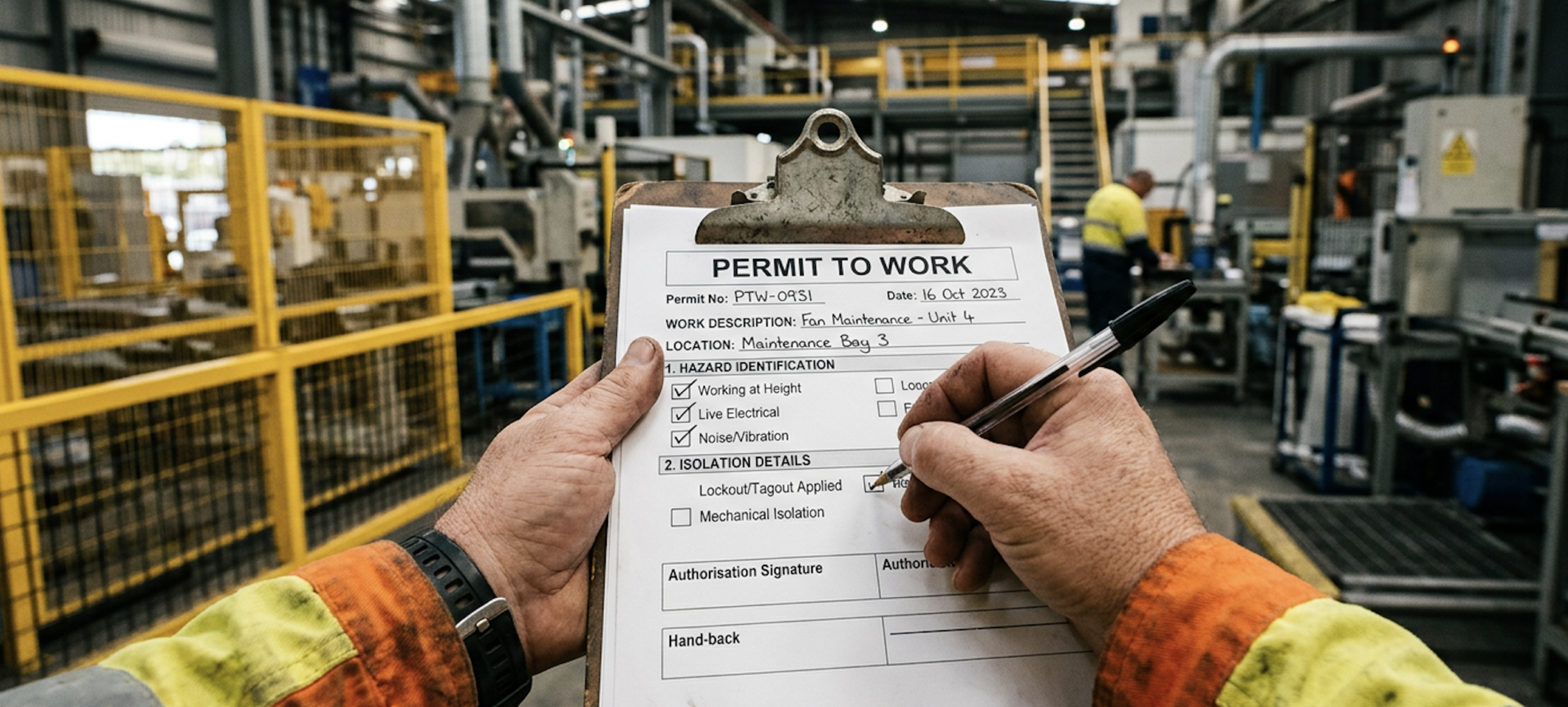
PTW Forms and Checklists are routinely treated as the substance of permit to work systems. They are not.
The permit form is not the system, and it is not the control. It records that the control exists and the verification has been carried out. But form design materially affects whether control actually holds. A well-designed form reinforces the system. A poorly designed one undermines it.
PTW Forms and Checklists: A Distinction Misunderstood Since Piper Alpha
On 6 July 1988, 167 men died on the Piper Alpha platform in the UK sector of the North Sea. Lord Cullen’s public inquiry concluded that one of the primary causes of the disaster was a failure in one of the key management systems – the permit to work system.
In direct response to Cullen, the industry that had produced the disaster set up its own task force to codify what a functioning PTW system required. The result was published in January 1993 as OGP Report 6.29/189, Guidelines on Permit to Work (P.T.W.) Systems. The document remains in circulation more than thirty years later. It has never been formally superseded.
The very first page of the 1993 document states the position plainly:
“A P.T.W is not simply permission to carry out a dangerous job. It is an essential part of a system which determines how that job can be carried out safely. The permit should not be regarded as a statement that all hazards and risks have been eliminated from the work area. The issue of a permit does not, by itself, make a job safe.”
That was the industry’s own conclusion, drafted by operators who had lived through what happens when this distinction is not understood. It is the same argument that runs through HSE’s HSG250 (2005/2010) and through every subsequent credible treatment of permit systems. It is not a contested position.
And yet, thirty years after Piper Alpha, many organisations still treat the permit form as the permit system. Some have no policy documentation at all. Some have procedures that exist only as a template the form uses. The form is filed, signed, and closed out – and the people operating the system believe, in good faith, that they are running a permit to work system. What they are running is a permit-issuing routine over safety arrangements that may or may not exist.
This is the distinction Page 5 of this hub set out in detail: the permit verifies that a safe system of work exists; it does not create one. Page 8 extends that argument one layer deeper. If the form is the evidence of verification, the design of the form determines what gets verified. A form with weak fields verifies weak controls. A form with ambiguous prompts produces ambiguous checks. A form that has never been properly designed produces an audit trail that demonstrates nothing.
Form design is not administrative polish. It is a competence, and it affects outcomes.
What a Permit Form and Is Designed to Do
A competently designed permit form does four things.
It identifies what is being authorised. The specific work, the specific location, the specific plant, the specific duration, and the specific people. Authorisation must be bounded, or it authorises nothing in particular – which means it authorises whatever the work party interprets it to mean. Ambiguity in scope is one of the routine contributors to PTW-related serious incidents.
It records that the preconditions for safe work have been established. Risk assessment completed. Safe system of work defined. Isolations applied and verified. Competent people identified. Supervision arrangements in place. Each of these must exist before the permit can be legitimately issued, and the form records that each has been checked – not claimed, not assumed, but checked at the work location by the person signing.
It creates an audit trail of accountability. Who authorised. Who received. Who verified isolation. Who tested the atmosphere. Who confirmed hand-back. Each signature is a statement of accountability that carries legal weight. When things go wrong, those signatures are the evidence of who was responsible for what at each stage. When things go right, they are the evidence that a managed system was operating as intended.
It makes the critical steps visible, traceable and auditable. Not just for the current work, but for future review. A permit record, retained for the statutory period, allows the organisation to examine how its system has been performing in practice whether issuers are completing all fields, whether close-outs are being properly verified – whether shift handovers are being recorded, whether patterns of incomplete documentation are emerging before they produce an incident.
None of these functions is administrative. Each is operational. A form that performs all four reinforces the permit system. A form that performs them incompletely or ambiguously leaves exactly the gap through which accidents pass.
The Case for Checklists – and Why the “New View” Position Fails the Honest Test
A permit form is, among other things, a structured checklist. Several sections of the form are explicitly checklist-based: the preparation and precautions checklist, the PPE checklist, the isolation verification, the gas testing record, the handover section. Each prompts the person completing it to verify a specific condition and record the result.
There is, in recent years, a school of thought in safety circles that checklists deskill operators, substitute for judgement, and should be abandoned or radically reduced in favour of professional discretion. The argument goes under various labels – Safety Differently, Safety-II, Human and Organisational Performance – and is articulated most prominently from Griffith University’s Safety Science Innovation Lab and a constellation of consultants and authors who follow that intellectual tradition.
The argument has a kernel of truth, which will be addressed in the next section. But the strong form of the position – that checklists are symptoms of low-trust management, that procedures actively reduce safety by substituting rules for judgement, and that the solution is to remove checklist-based controls in favour of operator autonomy – does not survive the honest test.
Consider the evidence.
The World Health Organization’s Surgical Safety Checklist was introduced in 2008. It is a 19-item checklist completed at three specific points during a surgical procedure: before anaesthesia, before incision, and before the patient leaves the operating room. It prompts verification of patient identity, surgical site, allergies, blood loss anticipation, antibiotic timing, equipment availability, and several other items.
Evaluations across multiple countries and hospital types have found consistent reductions in surgical complications and in mortality – in some studies, complication rates falling by more than a third and death rates by nearly half. The checklist does not replace the surgeon’s judgement. It does not deskill the anaesthetist. It prompts verifications that experienced professionals, under time pressure and cognitive load, occasionally miss – with fatal consequences when they do. The checklist catches those omissions.
The same evidentiary pattern exists in commercial aviation, where crew checklists have been a core safety control for decades, and where the airline industry’s safety record is the envy of every other sector. It exists in nuclear operations. It exists in pharmacy dispensing. Where checklists have been rigorously designed, implemented, and supported by understanding, they reduce harm. The evidence is not contested within the fields where checklists operate.
The cognitive science explains why.
Daniel Kahneman, Nobel laureate in economics, articulated in Thinking, Fast and Slow a two-system model of human cognition. System 1 is fast, automatic, intuitive, pattern-matching. It operates constantly, handles routine decisions without effort, and is remarkably reliable for tasks that are familiar and well-learned. System 2 is slow, deliberate, effortful, analytical. It handles novel problems, complex reasoning, and situations requiring focused attention.
Human beings default to System 1 whenever possible, because System 2 is metabolically expensive. Under time pressure, fatigue, distraction, or stress, the default intensifies. System 1 takes over, and System 2 recedes. This is not a failure of training or character. It is how the human brain works.
A well-designed checklist supports System 1 by making critical verifications automatic. The prompt arrives before the omission occurs. The check happens because the structure requires it, not because the operator happened to remember it during a routine they have performed a thousand times. Aviation pre-flight checklists exist because experienced pilots, under time pressure, occasionally forget to set flaps. Surgical checklists exist because experienced surgeons, under cognitive load, occasionally operate on the wrong limb. The checklist is a structural defence against the predictable limits of expert cognition.
The “new view” position, at its strong form, advocates for reliance on System 2 – for the operator to reason through each situation in full, using judgement and experience rather than structural prompts. This is not a safety philosophy. It is a prescription for exactly the failure mode that checklists were designed to prevent.
The isolation question.
The honest test of the position is simple. Ask a proponent of the strong “new view” critique of checklists whether they would advocate removing the isolation double-check from a permit system. The double-check exists because isolation errors have killed large numbers of people across multiple industries, and because a second pair of eyes catches errors that an experienced operator, however competent, occasionally misses.
No serious proponent will defend removing the isolation check. The moment the question is posed concretely rather than abstractly, the position collapses. Because the argument against checklists only functions at the level of abstraction. At the level of specific safety-critical verifications – the evidence that checklists save lives is overwhelming, and no credible person is prepared to stand publicly against that evidence.
The argument does not survive contact with the question.
This is not to dismiss everything the “new view” has contributed. There are genuine insights in that tradition about the limits of procedures, the role of professional judgement, and the failure modes of over-proceduralised workplaces. Those insights deserve engagement. But they do not justify the conclusion that checklists should be removed, and the people advancing that conclusion owe the industry a better answer than silence when the isolation question is asked.
The Limits of Checklists – Where “New View” Has a Fair Point
Checklists are not safety’s answer to everything. They are a tool, and like any tool they have failure modes, and the failure modes are real.
Tick-box culture. When checklists become routine and the person completing them no longer engages with the verification – when the ticks happen because the form demands them rather than because the check has been performed – the checklist has become paperwork. This is not a theoretical failure. It is a recurring contributor to incidents, and it is exactly the failure mode that “new view” critics rightly identify.
Checklists without understanding. A field on a form asking whether a specific condition has been verified is only meaningful if the person completing it understands what they are verifying. If the gas testing field is ticked by someone who does not understand the limits of the detector, what the readings mean, or which atmospheres require which tests, the record exists but the verification does not. This is a failure of competence, but the form design contributes to it when fields are written in technical shorthand that the users of the form were never properly trained on.
The illusion of comprehensiveness. A form with fifty fields may create the impression that fifty things have been checked. In reality, when a form is too long, users triage – some fields get real attention, others get routine compliance, and the discrimination between critical and routine checks is made implicitly by the person completing the form rather than deliberately by the person who designed it. Form design has to concentrate attention on the critical checks, not dilute it across too many.
Checklists that substitute for judgement. The strong “new view” argument is wrong, but the weak form of the argument is right: checklists do not replace thinking. A permit issuer who completes every field of the form without thinking about whether the specific work has hazards the form does not prompt for has misunderstood what the form is for. The form supports judgement; it does not replace it. A good permit system depends on competent issuers who use the form as a structured prompt, not as a substitute for their own assessment.
The critical-checks principle. Not everything can be checked. Trying to check everything produces forms that nobody can complete properly, and creates the tick-box culture that undermines the whole system. Good checklist design concentrates on the critical verifications the ones whose omission has killed people before, the ones where the consequence of failure is catastrophic, the ones where expert cognition is known to fail under pressure. Isolation. Gas testing. Hand-back. Shift handover. Competence of the work party. These are the checks that earn their place on the form, because these are the checks whose absence produces the incidents the form exists to prevent.
Everything else is context, supporting detail, or administrative overhead – and when it crowds out the critical checks, it does active harm.
From OGP 1993 to HSG250 to Today – The Evolution of Permit Form Design
Three reference documents bracket the development of UK and international permit form design.
OGP Report 6.29/189 (January 1993). Drafted in direct response to Piper Alpha. Section A, The Permit to Work Form, begins: “The core of the P.T.W system is the form itself.” It lists twelve items of information that should typically appear on the form: description of task, location and plant numbers, details of work party and tools, details of potential hazards, details of precautions taken, details of protective equipment, other persons to be notified, time of issue and period of validity, signature of person in charge of work, signature of person issuing the permit, signature for handover, and signatures for completion and cancellation.
Twelve fields. Derived from the specific failure modes of Piper Alpha and the accumulated experience of a task force drawn from major operators. It has aged well. Every item on the list remains necessary in 2026.
HSG250, Guidance on permit-to-work systems (HSE, 2005, revised 2010). The UK regulator’s guidance, applicable to petroleum, chemical and allied industries. HSG250 specifies thirteen “essential elements” of a permit-to-work form: permit title, permit reference number, job location, plant identification, description of work and its limitations, hazard identification, precautions necessary and actions in emergency, protective equipment, issue, acceptance, extension/shift handover, hand-back, and cancellation.
Thirteen fields. The specification is broadly consistent with OGP 6.29/189, with the addition of a formal hazard identification step and a more structured separation between issue and acceptance. Both documents treat their specifications as essential elements – floors, not ceilings.
Oracle Safety (2026). Thirty years of operational experience across mining, petrochemical, manufacturing, food production, construction and media operations have produced a working specification of thirty-two fields grouped into six logical sections. The expansion from twelve or thirteen fields to thirty-two is not a proliferation of bureaucracy. It is the accumulation of lessons from incidents that the 1993 and 2005 specifications did not adequately protect against.
Some of the additions reflect gaps that became apparent after the original specifications were written: nearby work and adjacent permit interactions (which Page 6 of this hub identified as a significant failure mode); explicit isolation detail separate from the general precautions field; gas testing as a dedicated section rather than a subset of precautions; issuer’s periodic checks during the work (not merely at issue and close-out); and a formal post-work evaluation loop feeding back into system improvement.
Others reflect operational realities that the earlier specifications underweighted: competent workers record (documenting who is actually on the work party, not just who the supervisor is); signatures of key action performers (isolator, gas tester, specialist contractors) so accountability for specific controls is recorded; cross-referencing to related permits where concurrent work exists; review and amendment log for changes made during active work; and a distribution list to ensure everyone who needs to know about the work actually does.
The 32-field structure is not proposed as a new international standard. It is the specification Oracle Safety uses when designing or reviewing permit forms, and it reflects the failure modes that have been observed in practice over thirty years. Organisations should adopt or adapt it according to the specific risks their operations present.
The point of the comparison is different. It is that form design is not frozen in 1993. The industry has continued to produce permit-related incidents despite the existence of HSG250, because HSG250’s thirteen essential elements are a minimum a skeleton and because the field gaps between the thirteen and what is actually needed have produced the incidents the Health and Safety Executive has investigated since.
The Anatomy of a Well-Designed Permit Form
The 32 fields that follow are organised into six logical sections reflecting the sequence of permit operation: identification, preconditions, authorisation, during the work, transfer and close-out, and supporting fields. Each section addresses a specific phase of the work. Each field within the section has a specific purpose. Together they form a complete audit trail from request through to post-work evaluation.
Section 1: Identification – what work is being authorised
1. Permit title: the type of permit (general work, hot work, confined space, electrical, excavation, etc.). Categorises the permit for administration and retrieval.
2. Permit reference number: a unique identifier. Tracks the permit individually and enables cross-reference to related documents.
3. Job description: a precise account of the task to be undertaken. Ambiguity here undermines everything downstream.
4. Job location / equipment / plant: the physical location, the specific plant item, the reference numbers. Enables coordination, hand-over, and accurate cross-reference.
5. Risk assessment reference: the specific risk assessment that underpins this work. Without a current, task-specific risk assessment, the permit cannot be legitimately issued. The form records the link.
6. Safe system of work / method statement: the documented method by which the work will be carried out. Again: the permit verifies this exists. The form records the reference.
Section 2: Preconditions – what must be in place before authorisation
7. Nearby work and concurrent permits: other active permits on related plant, or other work occurring in the vicinity. Page 6 of this hub identified uncoordinated concurrent permits as a significant failure mode; this field is where that coordination is recorded.
8. Preparation and precautions checklist: the specific verifications required for this work. Structured as a checklist to support the issuer’s System 1 cognition and prevent omissions under time pressure.
9. Hazard recording: a dedicated space for hazards identified at the work location that were not anticipated by the risk assessment. Adapts to conditions as they actually are, not as the documentation predicted.
10. PPE checklist: the specific protective equipment required. Not generic; task-specific and location-specific.
11. Isolation details: the energy sources isolated, the isolation methods applied, the tag numbers, the proving results. This is the field that protects against the largest category of PTW-related serious incidents.
12. Gas testing confirmation: for confined space and hot work permits, the atmospheric testing results. Flammability, toxicity, oxygen content. With timestamps.
13. Emergency response plan reference: the specific emergency procedures relevant to this work and location. Not a generic reference; specific.
Section 3: Authorisation – formal accountability for the decision to proceed
14. Authorisation: the permit issuer’s signature confirming that all preconditions have been verified and work is authorised to proceed. The signature carries legal weight.
15. Receipt: the permit receiver’s signature confirming that the permit conditions are understood, the hazards are understood, and the work party has been briefed.
16. Signatures of key action performers: specific signatures from the isolator, the gas tester, and any other person who has completed a safety-critical step. Accountability for individual controls, not just for the permit as a whole.
17. Competent workers record: the names of the people actually working under the permit. Provides the audit trail showing that only authorised and competent persons performed the work.
18. Time limits: the date and time of issue, the validity period, and any specific time-based conditions. Enables revalidation and prevents permits drifting beyond their assessed scope.
19. Worker signatures: an explicit acknowledgement from the work party that the briefing has been received and the hazards are understood. Personal accountability at the level of the individual worker.
Section 4: During the work – sustaining control across the duration
20. Awareness of adjacent work: ongoing awareness of non-permit activities in the vicinity that may affect the work or be affected by it. Recorded and updated during the work, not only at issue.
21. Review and amendment log: any changes to the permit conditions during the work. Scope extensions, precaution changes, time extensions – all recorded with authorisation.
22. Issuer’s periodic checks: a log of the issuer’s site visits during the work, with observations and timings. Demonstrates that supervision has continued beyond issue and is not assumed.
23. Cross-referencing to related permits: updates as other permits are issued or closed on related plant during the work period.
Section 5: Transfer, suspension and close-out – how control exits safely
24. Transfer of responsibilities: the formal mechanism for passing permit accountability across shifts or between supervisors. Requires verification that conditions remain as recorded and that the incoming person has been properly briefed.
25. Suspension authorisation / verification: the process for temporarily halting work while preserving the permit. Records the reason for suspension, the conditions during suspension, and the authorisation for resumption.
26. Clearance / completion: the work party’s confirmation that the work is complete and the site has been left safe. Must include physical inspection of the work area, not merely verbal confirmation.
27. Hand-back: the issuer’s confirmation, based on inspection, that the plant can be returned to normal service. The close-out signature that enables re-energisation and restoration of normal operations.
28. Cancellation: formal termination of the permit. Distinct from completion a permit may be cancelled before work is complete for operational reasons, and that state requires its own record.
29. Post-work evaluation: any observations, near-misses, scope issues, or lessons from the work that should feed into future permit design or system improvement.
Section 6: Supporting fields – the documentation that makes the form operational
30. Colour coding: where multiple permit types are in use, a visual convention for rapid identification of permit category.
31. Distribution list: the parties who receive copies: work site, control room, issuer, relevant supervisors. Ensures everyone who needs to know, does.
32. Attachments: space to list or attach supporting documents: isolation drawings, risk assessments, method statements, specialist reports. The form is the record; the attachments are the evidence.
Common Form Design Failures
Even well-intentioned permit forms fail in recognisable patterns.
Generic templates applied to specialist work. A form designed for general maintenance applied to a confined space entry, or a hot work permit applied to work with radiological implications, misses the specific checks that matter for the actual hazard. Permits should be task-category-specific, with distinct forms for hot work, confined space, electrical, excavation, and other high-risk work types – not one universal form with a “type of work” dropdown.
Forms that read as legal cover rather than operational control. Some permit forms are designed primarily to produce a record that demonstrates due diligence after an incident, rather than to prompt the verifications that prevent the incident. The tell is excessive legal language, complex waivers, and fields that capture liability assignments rather than safety conditions. Operational control and legal defensibility are not opposites, but when the form prioritises the second at the expense of the first, something has gone wrong.
Forms where the checks aren’t understood by the people completing them. A permit form is only as good as the competence of the issuer and receiver. When fields prompt for verifications that the person completing the form does not fully understand gas test interpretation, isolation methods, hazard category, the tick is not a verification, it is a guess. Fields should be written at the level of understanding of the people who will actually use them, and training must support that understanding. A form the users do not understand is a failure mode regardless of how elegant its design.
Tick-box sections with no requirement to verify the actual condition. A checkbox on a form prompts the question “has this been checked?” but does not, on its own, prove that it has. Well-designed forms require the signer to record the specific result of the check, not merely its occurrence. “Isolation applied: Yes / No” is weaker than “Isolation method, tag numbers, and proving results: [specific entry]”. The second prevents defaulting to the tick.
Forms that grow by accretion and never get smaller. Every incident produces a new field. Nothing ever gets removed. Over decades the form accumulates until it is unusable, fields contradict each other, sections are obsolete, the critical checks are buried among dozens of minor ones. Form design is an ongoing discipline; forms should be reviewed periodically and simplified as well as extended.
Signatures as theatre. Fields signed because they are there, not because the verification has happened. This is the tick-box culture writ large: the signature confers the illusion of accountability without the substance. It is the failure mode most directly responsible for post-incident investigations finding that permits were in place, signatures existed, and controls were absent.
Digital Permit Systems – The Software Does Not Redeem the Form
Digital permit to work systems are being marketed aggressively across UK industry. The claimed benefits are real: improved traceability, real-time visibility, automated retention, searchable records, reduced paper handling. For organisations operating large numbers of concurrent permits across multiple sites, a properly-implemented digital PTW system genuinely improves administrative efficiency.
But administrative efficiency is not the purpose of a permit system, and a digital system does not redeem poorly-designed PTW Forms and Checklists.
The underlying field structure is the control. If the fields are weak, the digital version is a weak permit system that produces data more efficiently. If the fields do not prompt for the verifications that matter, digital storage of the omissions does not correct them. If the users do not understand the fields, a tablet-based interface does not confer understanding.
Digital systems can, when well-designed, enforce sequence (the receiver cannot sign before the issuer has; hand-back cannot occur before clearance; isolations cannot be removed before cross-referenced permits are closed). That is a genuine improvement over paper systems, where sequence is a matter of discipline. Digital systems can also support real-time audit across multiple sites and produce better data for governance review.
But well-designed paper PTW Forms and Checklists beat a badly-designed digital form, every time. Organisations considering a move to digital PTW should first ensure the form they are digitising is itself competently designed. Digitalisation captures data; it does not fix the underlying design.
How Far Do We Go?
Good design of PTW Forms and Checklists finds the line between two failure modes.
Under-specified forms miss critical verifications. The fields that would catch the error are absent. The tick-box assures compliance with the form while the actual hazard remains uncontrolled. Organisations with under-specified forms often do not recognise the problem until an incident exposes it.
Over-specified forms become administrative theatre. So many fields, so much required detail, that completion becomes a procedural exercise in its own right. Users triage, critical checks receive the same level of attention as trivial ones, because the form treats them the same. Understanding is diluted across the volume. The critical checks are still present, but they are no longer distinguished from the administrative ones, and they no longer concentrate attention the way they were designed to.
The line between the two is not universal. It depends on the operation, the work type, the risk profile, and the competence of the users. High-risk petrochemical plant with experienced issuers and receivers can support a more detailed form than a light-engineering workshop with occasional permit requirements. A hot work permit in a flour mill requires different fields from a hot work permit on a chemical reactor. Generic design of PTW Forms and Checklists produces either the under-specification or the over-specification problem; task-specific design, developed by the people who will actually use it, produces the balance.
The design principles are straightforward to state and harder to execute:
Designed by users. The people who will complete the form should participate in its design. Forms designed by consultants or head-office functions without operational involvement routinely produce fields that do not match the work as performed.
Tested against the work. The form should be tested on a representative sample of actual work, not evaluated on paper. Fields that sound right in a design review often fail when applied to real tasks.
Reviewed after incidents. When a PTW-related incident or near-miss occurs, the form design should be part of the investigation. Did the form prompt for the check that was missed? Was the check understood? Would a differently-designed form have caught the error?
Simplified as well as extended. The tendency is to add fields after incidents. A disciplined design review removes fields that are not adding value, so the critical ones retain their prominence.
Supported by competent users. Form design is necessary but not sufficient. Users must understand each field, know why it is there, and be able to complete it meaningfully. Training is not separate from form design; it is part of what makes form design work.
Summary
The permit to work form is not the system. It records that the system is operating. Form design is a competence that materially affects whether control holds, and the evidence for this has been understood since Piper Alpha.
OGP 6.29/189 (1993) and HSG250 (2005/2010) specify essential elements that no credible permit system omits. The specifications are a floor, not a ceiling. The gap between these essential elements and what is actually required to control the failure modes that continue to produce incidents is the space that better-designed forms occupy.
Checklists are a proven safety control. The cognitive science is clear, the empirical evidence from aviation, surgery and nuclear operations is overwhelming, and the industry that produced Piper Alpha adopted checklists in direct response to what Piper Alpha exposed. The strong “new view” critique of checklists that they should be abandoned in favour of operator judgement, cannot survive the honest question about isolation checks, and should not be taken seriously as a safety philosophy. The weak form of the critique, that checklists can become tick-box culture and must be supported by competence and understanding, is correct and useful.
A well-designed permit form concentrates attention on the critical verifications, supports System 1 cognition under pressure, creates a defensible audit trail of accountability, and produces data that can feed back into system improvement. The 32-field structure presented above represents one working specification. Organisations should adapt it to their risks, but the underlying principles that the form is the evidence of control, that design matters, that the checklist is a necessary defence against the predictable limits of human cognition are not optional.
Digital systems are useful when the underlying form is well-designed. They do not redeem a poorly-designed form. Organisations moving to digital PTW should invest in the design before the software.
And finally: form design, like every other element of competent PTW management, is a continuous discipline, not a one-time exercise. Forms should be reviewed, tested, simplified, extended, and supported by ongoing competence development. The form that was adequate five years ago may not be adequate today. The industry has continued to produce PTW-related incidents because form design has not kept pace with the lessons of those incidents. The remedy is to treat form design as the operational competence it is, not as paperwork, and not as an administrative afterthought.
Frequently Asked Questions
Is a permit to work the same as a checklist?
No. A checklist is a structured prompt for verifying specific conditions. A permit to work is a formal authorisation system that uses checklists as part of its substance, but extends well beyond them — covering issuer and receiver competence, isolation verification, time limits, periodic checks, and formal hand-back. The checklist sections within a permit form are necessary but not sufficient on their own.
What’s the difference between OGP 6.29/189 and HSG250?
OGP 6.29/189 (1993) was drafted by an oil and gas industry task force in direct response to the Piper Alpha disaster. HSG250 (2005, revised 2010) is the UK Health and Safety Executive’s guidance on permit-to-work systems, applicable to petroleum, chemical and allied industries. The two documents are broadly consistent: OGP recommends twelve fields on the form, HSG250 specifies thirteen essential elements. Both treat their specifications as a floor, not a ceiling.
How many fields should a permit to work form contain?
There is no single correct number. HSG250 specifies thirteen essential elements as a minimum. Oracle Safety’s working specification of thirty-two fields reflects thirty years of operational experience and addresses gaps that the older specifications did not adequately protect against. The right number depends on the operation, the work type, the risk profile, and the competence of the users – task-specific design produces the right balance, generic templates do not.
Are digital permit-to-work systems better than paper?
Not inherently. A well-designed digital system can enforce sequence, support real-time audit and produce better data for governance review. A poorly-designed digital system is a poorly-designed permit system that produces data more efficiently. The underlying form structure is the control, not the medium. Organisations considering a move to digital should ensure the form they are digitising is itself competently designed first.
Should checklists be replaced with operator judgement?
No. The “new view” position that checklists deskill operators and should be replaced by judgement does not survive contact with the evidence. The World Health Organization’s Surgical Safety Checklist has produced consistent reductions in surgical complications and mortality. Aviation, nuclear, and pharmacy operations rely on checklists for the same reason. Kahneman’s cognitive science explains why: under time pressure and cognitive load, expert judgement misses things checklists catch. The remedy for tick-box culture is competent users and well-designed checklists, not the abolition of checklist
What makes a permit form fail?
Six recurring patterns: generic templates applied to specialist work; forms designed as legal cover rather than operational control; fields that the people completing the form don’t understand; tick-box sections that don’t require recording the actual result of the check; forms that grow by accretion and never get smaller; and signatures completed because the field exists rather than because the verification has happened. Form design is an ongoing competence, not a one-time exercise.