

Managing Contractors Training | Contractor Control Systems
Designing and operating effective contractor control systems
Managing Contractors Training helps organisations plan, select, control and review contractor work. This course explains the HSE’s five-step approach, contractor competence, supervision, permit to work requirements and legal duties
Contractors are routinely engaged to undertake higher-risk, non-routine, and specialist activities. When incidents occur, the root cause is rarely a lack of paperwork. It is almost always a failure of system design, accountability, or policy enforcement.
This course is designed for organisations that need contractor control arrangements that work in practice, withstand scrutiny, and can be evidenced if challenged.
It is not a RAMS checking course. It is not a compliance awareness session. It is a structured, standards-based programme focused on building and operating a defensible contractor control system.
Who this course is for
This course is designed for those with real responsibility for contractor work, including:
- Senior managers with accountability for contractor control
- Engineering and maintenance managers
- Project managers and CDM duty holders
- Permit to work issuers and site managers
- Health and safety professionals responsible for system design or audit
It is particularly suited to organisations operating in manufacturing, engineering, utilities, facilities management, and project environments where contractor risk is significant.
What makes this Managing Contractors Training course different
Most contractor training focuses on what contractors should do. This course focuses on what the client organisation must design, decide, and control.
The course is built around three principles:
- Contractor control is a management system, not a form
- Policy must be measurable and auditable
- Responsibility and competence must be explicit
Delegates leave with a clear understanding of how to design and operate a contractor control system that aligns with UK law, HSE guidance, and ISO based management standards.
The 5-Step Contractor Control System
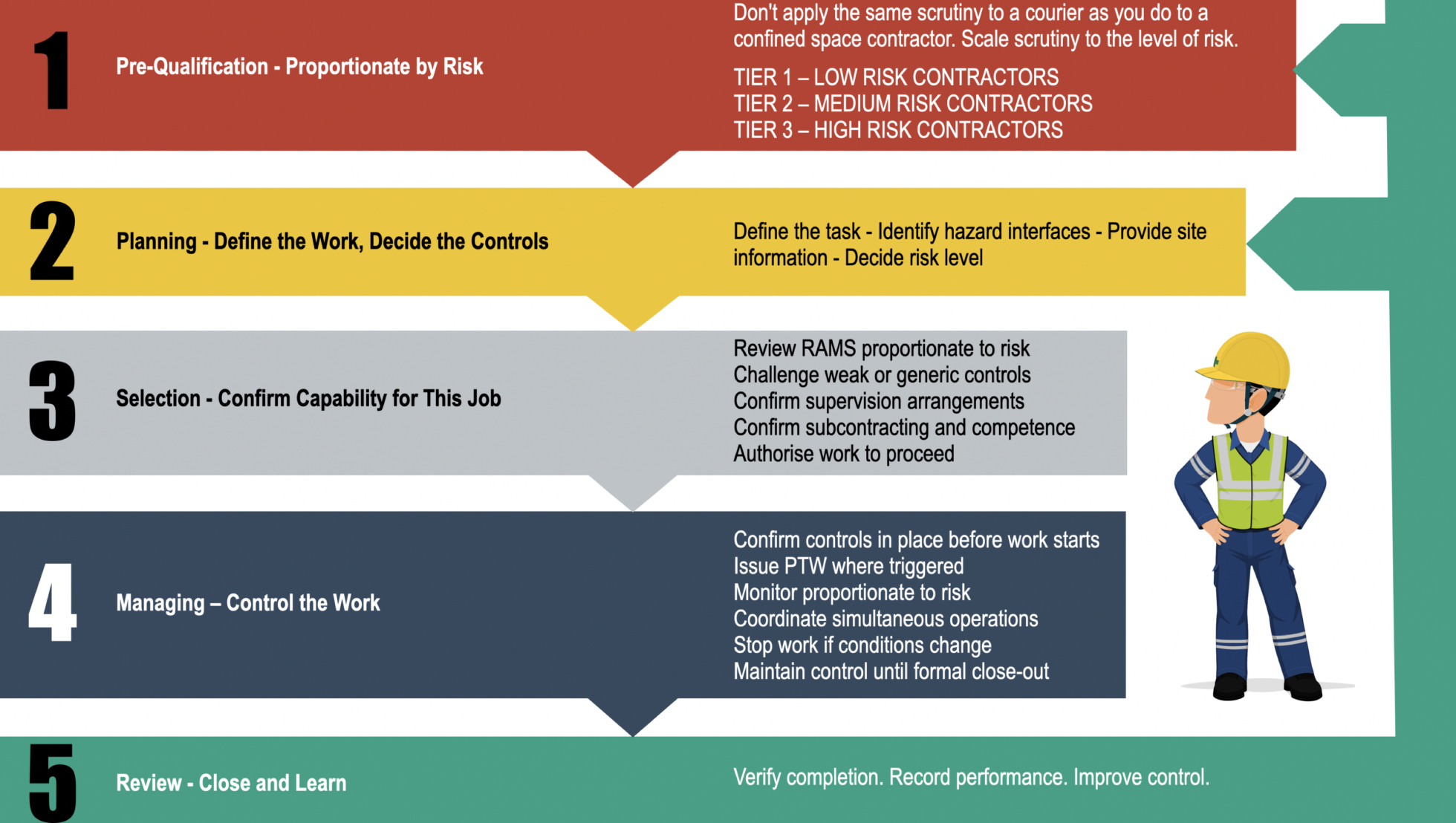
The course is structured around the 5-Step Contractor Control System, which treats contractor control as a lifecycle rather than a single approval point.
- Pre-qualification – Establishing assurance that contractors have the capability, capacity, competence, and management maturity required for the work.
- Planning – Client-side definition of scope, hazards, interfaces, information requirements, and minimum safety standards before contractor methods are developed.
- Selection – Selecting contractors based on competence and control capability, not cost or convenience alone.
- Managing the work – Active management of contractor activities through induction, supervision, permit to work interfaces, change control, and coordination.
- Review and learning – Formal post-job evaluation feeding back into approved contractor lists, planning standards, and future contractor engagement.
Each step is examined in detail, with clear decision points and accountability requirements.
When Is a Permit to Work Needed for Contractors?
Most contractor work can be managed through planning, competence checks, site rules, supervision and suitable risk assessments.
A permit to work is normally only needed where the work is higher risk, non-routine, or where a failure could have serious consequences. It is particularly important where contractors are working on live plant, where several parties are involved, or where the work could affect other people on site.
Typical examples include:
Both parties agreeing the precautions, supervision and limits of the job
One of the most common failures is where a client insists on issuing permits but does not really understand the hazards or the checks required. A permit signed by someone who does not understand isolations, gas testing, confined spaces or simultaneous operations is not a control measure. It is just paperwork.
The HSE is clear that anyone responsible for permits and contractor control must have enough knowledge about the risks, precautions and safe methods involved.
- Hot work
- Confined space entry
- Excavation and breaking ground
- Roof work and fragile surfaces
- Live electrical work
- Isolation of plant or services
- Breaking containment on dangerous systems
- Intrusive maintenance on operational plant
A permit to work should not replace contractor management. It is simply one additional control within a wider contractor management process. For higher-risk work, both are needed.
A permit to work should not replace contractor management. It is simply one additional control within a wider contractor management process. For higher-risk work, both are needed.
Who Should Control the Permit to Work?
A common question is whether the client or the contractor should control the permit to work.
In practice, the answer is often both. The client normally controls the site permit because they understand the wider risks created by the workplace itself. They know about:
- Other work taking place nearby
- Existing isolations
- Hidden hazards such as asbestos, buried services or residual chemicals
- Site rules and emergency arrangements
- Interactions with other contractors or operations
The contractor may then operate their own task-specific permit or safe system of work within that framework. For example, an electrical contractor may use their own electrical isolation certificate, or a roofing contractor may use their own roof-work permit.
The safest arrangements usually involve:
- The client authorising the work on their site
- The contractor controlling the technical detail of how the work is carried out
- Both parties agreeing the precautions, supervision and limits of the job
One of the most common failures is where a client insists on issuing permits but does not really understand the hazards or the checks required. A permit signed by someone who does not understand isolations, gas testing, confined spaces or simultaneous operations is not a control measure. It is just paperwork.
The HSE is clear that anyone responsible for permits and contractor control must have enough knowledge about the risks, precautions and safe methods involved.
Contractor Management Under CDM 2015
Many maintenance, installation and engineering projects also fall within the definition of construction work under CDM 2015. This is one of the most common areas of non-compliance in industry.
Organisations often assume CDM only applies to building sites, new buildings or major construction projects. In reality, it frequently applies to maintenance shutdowns, plant upgrades, new machinery, service installations, structural alterations, office refurbishments, roof work and intrusive engineering activities.
If the work involves construction work and more than one contractor, the client usually has legal duties to appoint:
- A Principal Designer during the design and planning stage
- A Principal Contractor during the construction phase
These appointments must be made in writing before work starts.
Many organisations miss this completely. They appoint contractors, ask for a risk assessment and method statement, perhaps even issue a permit to work, but fail to recognise that they have already triggered CDM duties.
A permit to work does not replace CDM. Neither does a contractor’s Risk Assessment and Method Statements (RAMS pack).
Under CDM 2015, clients must also ensure:
- Suitable arrangements are in place for managing the project
- Contractors and designers are competent and adequately resourced
- Relevant pre-construction information is provided
- Risks are coordinated between different contractors
Policy as a measurable control
A core element of the course is the design of contractor control policy as an operating control, not a statement of intent.
Delegates are shown how to build policy on measurable standards that can be tested through:
- Documentary evidence
- Face-to-face discussion with duty holders
- Observation of contractor activities
Where evidence does not exist, non-compliance must be assumed. This principle runs throughout the course and underpins its practical credibility.
Standards-based system design
The Managing Contractors Training course uses defined contractor control standards derived from:
- UK statutory duties, including HASAWA 1974 and MHSWR 1999
- HSE guidance on contractor management and coordination
- ISO 45001 leadership, competence, procurement, communication, and performance clauses
Delegates learn how to translate these requirements into clear policy standards, including:
- Named senior management accountability
- Defined competence criteria for client-side roles
- Proportionate contractor pre-qualification
- Verified RAMS review and approval
- Defined supervision levels based on risk
- Formal post-job review and learning
Each standard is measurable and auditable.
Integration with RAMS, permit to work, and CDM
The Managing Contractors Training course shows how contractor control systems must integrate with existing arrangements rather than sit alongside them.
This includes:
- Using RAMS as inputs, not controls in themselves
- Positioning permit to work systems as control interfaces, not permission slips
- Anticipating and managing CDM duties where construction work thresholds are met
Delegates gain clarity on when CDM applies, when it does not, and how contractor control processes support legal compliance.
Practical application and decision-making
Throughout the course, delegates work through realistic scenarios to test decisions, not just knowledge.
This includes:
- Categorising contractor risk
- Deciding proportionate control measures
- Assessing competence and supervision requirements
- Determining when work must stop or be redesigned
- Recording decisions to demonstrate due diligence
The emphasis is on defensible judgement, not box-ticking.
Course duration and delivery
The Managing Contractors Training course is delivered over one day. A two-day option is available where greater depth, site-specific application, or assessment is required.
Delivery options include:
- In-house classroom delivery
- Virtual delivery via Teams or Zoom
- Sector-specific tailoring and examples
Course tutor
The course is delivered by Phil Douglas, Chartered Health and Safety Professional with over three decades of experience designing and operating contractor control systems across high-risk industries.
Phil’s practical knowledge of contractor control predates the introduction of the CDM Regulations. His approach was shaped in the 1980s through the design and implementation of real contractor control systems following serious incidents and fatalities, where failures of planning, supervision, and accountability had direct and irreversible consequences.
This experience underpins the course’s emphasis on system design, clear authority, measurable standards, and defensible decision-making. CDM 2015 is addressed in full, but it is treated as one part of a broader contractor control framework rather than the starting point.
The course reflects how contractor risks are actually managed in complex, high-hazard environments, not how they are described in guidance notes.
What organisations gain
Organisations attending this course gain:
- Clear understanding of contractor control responsibilities
- A structured, standards-based control system
- Reduced reliance on generic paperwork
- Improved contractor performance over time
- Confidence under inspection, investigation, or audit
Course availability and suitability
This course is intended for organisations that need contractor control arrangements that work in practice, not just on paper.
If your organisation relies on contractors to carry out critical, high-risk, or non-routine work, and you want a contractor control system that is structured, measurable, and defensible, this course provides the framework to do so.
To discuss suitability, delivery options, or tailoring the course to your organisation, contact Oracle Safety Associates.
Questions and Answers
What is Managing Contractors Training?
Managing Contractors Training helps organisations plan, select, control and review contractor work. It is particularly important where contractors carry out higher-risk, non-routine or specialist activities. The HSE makes clear that effective contractor management starts before the contractor arrives on site and continues through to reviewing the completed work.
Who Should Attend Managing Contractors Training?
This training is suitable for managers, supervisors, engineers, project managers, procurement teams, facilities staff and anyone responsible for appointing or overseeing contractors.
What Are the Five Key Steps to Managing Contractors?
The HSE recommends a five-step approach:
- Planning the work
- Choosing a suitable contractor
- Controlling contractors while they are on site
- Checking how the work is being carried out
- Reviewing the completed work afterwards
Why Is Planning Important Before Contractors Arrive on Site?
Organisations should define the work clearly, identify hazards, assess the risks, and decide what standards, controls and supervision are required before the contractor starts work. Poor planning is one of the main causes of contractor accidents.
How Do You Choose a Competent Contractor?
Competence should be assessed using evidence such as:
- Previous experience
- Training records and qualifications
- References and previous performance
- Supervision arrangements
- Accident history
- The quality of risk assessments and method statements
- Whether subcontractors will be used
- Whether the contractor has enough people, equipment and time to do the job safely
What Information Should Be Given to Contractors Before Work Starts?
Contractors should receive clear information about:
- Site hazards and restrictions
- Emergency arrangements
- Welfare facilities
- Traffic routes and pedestrian routes
- Site rules and local procedures
- Asbestos, buried services and other hidden hazards
- Who is supervising the work
- Who to contact if conditions change
Is Contractor Management the Same as a Permit to Work System?
No. Contractor management covers the whole process of planning, selecting, supervising and reviewing contractor work. A permit to work is only one control measure and is normally reserved for higher-risk tasks such as hot work, confined space entry, roof work, electrical isolation or intrusive maintenance.
When Is a Permit to Work Needed for Contractors?
A permit to work is normally required where work is high risk, non-routine, involves multiple parties, or could create serious consequences if controls fail. Typical examples include:
- Hot work
- Confined space entry
- Excavation
- Roof work
- Live electrical work
- Work on dangerous plant or services
Why Is Supervision Important When Contractors Are On Site?
Contractors should not simply be left to get on with the job. The level of supervision should reflect the risks involved, the complexity of the work and the competence of the contractor. The HSE recommends regular checks to confirm that agreed controls are being followed and that the work has not changed from the original plan.
Why Should Contractor Performance Be Reviewed After the Work Is Complete?
Reviewing contractor performance helps organisations identify what went well, what problems arose, and whether the contractor should be used again. It also helps improve future contractor arrangements and standards. Lessons learned should be fed back into future contractor selection, planning and supervision.