Permit to Work · Knowledge Hub · Page 7 of 9
Permit to Work Policy and Procedures
The three documented components of a competent PTW system – policy and arrangements, supporting procedures, and the permit form – and how they integrate with the wider safe system of work.
Verification · Coordination · Control
PTW policy and procedures are the documented foundation of a competent PTW system. Alongside the permit form itself, they make up the three documented components on which the system rests: the policy and arrangements that establish authority and rules, the procedures that translate them into operational practice, and the permit form that records control at the task level. This page covers each component in turn, how they relate to the wider safe system of work, what monitoring and assurance arrangements a working system requires, and the legal framework that gives the documentation its weight. Written for safety practitioners, duty holders, and those responsible for designing, operating, or auditing permit to work systems.

What is a Permit to Work system?
A Permit to Work system is a formal, recorded process used to control work that has been identified as hazardous. When designed and used in accordance with law, guidance and recognised international good practice, it helps ensure that health and safety controls are in place and functioning:
- before work starts
- while work is underway
- and when work is completed or handed over
A competent PTW system is documented in three connected ways:
- The Permit to Work policy and arrangements
- The procedures that support and give effect to the policy
- The Permit to Work recording forms
These elements are inseparable. Removing or weakening any one of them undermines the whole system.
The purpose of a PTW system is not to create paperwork. It is to make critical controls reliable, visible, and verifiable.
PTW Policy and Procedures: The Three Documented Components
Every functioning PTW system is built on the same documentary structure.
1. The Permit to Work policy and arrangements
This sets the organisational rules, authority, and expectations for how the system operates.
2. Permit to Work procedures
These translate policy into practical, repeatable actions that reflect how work is actually carried out.
3. Permit to Work forms
These record decisions, confirmations, and handovers at the task level. None of these elements works in isolation. A well-designed form cannot compensate for weak governance. A policy without procedures is unenforceable. Procedures without competent people are bypassed.
Permit to Work policy and arrangements
The Permit to Work policy arrangement explains how the organisation plans, organises, controls, monitors, and reviews the PTW system. It should define clearly:
- when a Permit to Work is required and when it is not
- who has authority to approve, issue, suspend and cancel permits
- competence requirements for permit issuers and receivers
- interfaces with other control processes, including:
- risk assessment
- isolation and energy control
- contractor management
- emergency arrangements
- how the system is monitored, audited and reviewed
This is not guidance. It is the rule set that gives the system legal and managerial force. Without clear policy arrangements, PTWs become optional paperwork rather than mandatory controls.
Permit to Work procedures
Procedures explain how the system operates in practice. They should cover, in clear and usable terms:
- how permits are requested
- how permits are issued and authorised
- how handovers between shifts or work groups are managed
- when and how permits are suspended or revalidated
- how permits are cancelled and closed out
Procedures must reflect reality. If they cannot be followed in the field, they will be worked around. When that happens, the system no longer controls risk, even if forms continue to be completed.
The Permit to Work form
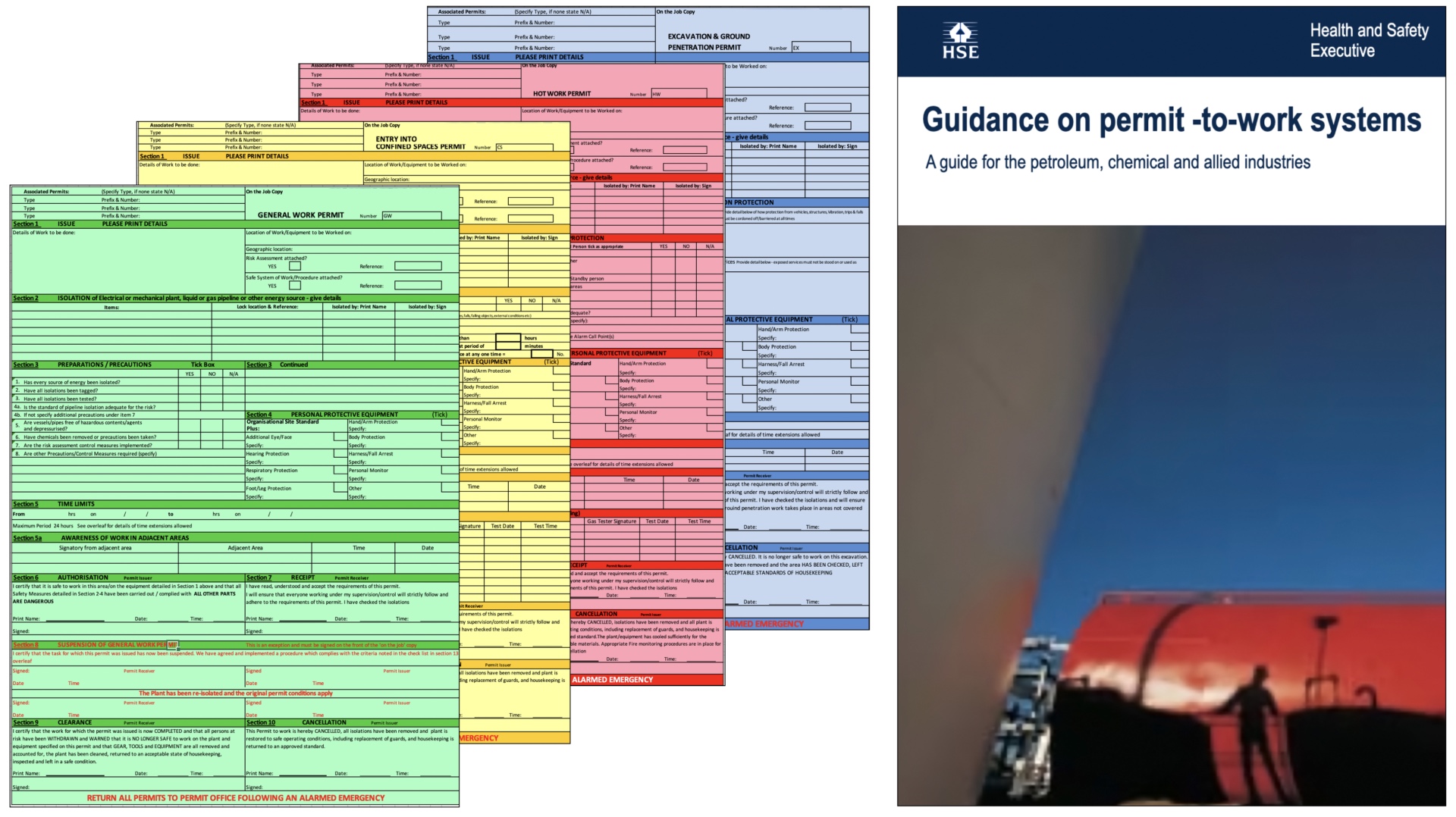
The Permit to Work form is the document completed by a competent Permit Issuer, in conjunction with the Permit Receiver, to record the permit activity. There may be different forms for different types of work. Which form is used, and when, must be directed by the policy and supported by training. The PTW form must never be viewed as simply “permission to start a task”.
It is a record of control, capturing:
- task-specific hazards
- confirmation that required controls are in place
- isolation and verification where applicable
- supervision and handover arrangements
- suspension, reissue, and cancellation
The Permit to Work recording form does not create control. It records that control exists and remains valid. UK guidance on permit-to-work systems is published by the Health and Safety Executive in HSG250 and is worth consulting when designing Permit to Work forms. The original publication can be accessed here for the full guidance.
Permit to Work within the wider safe system of work
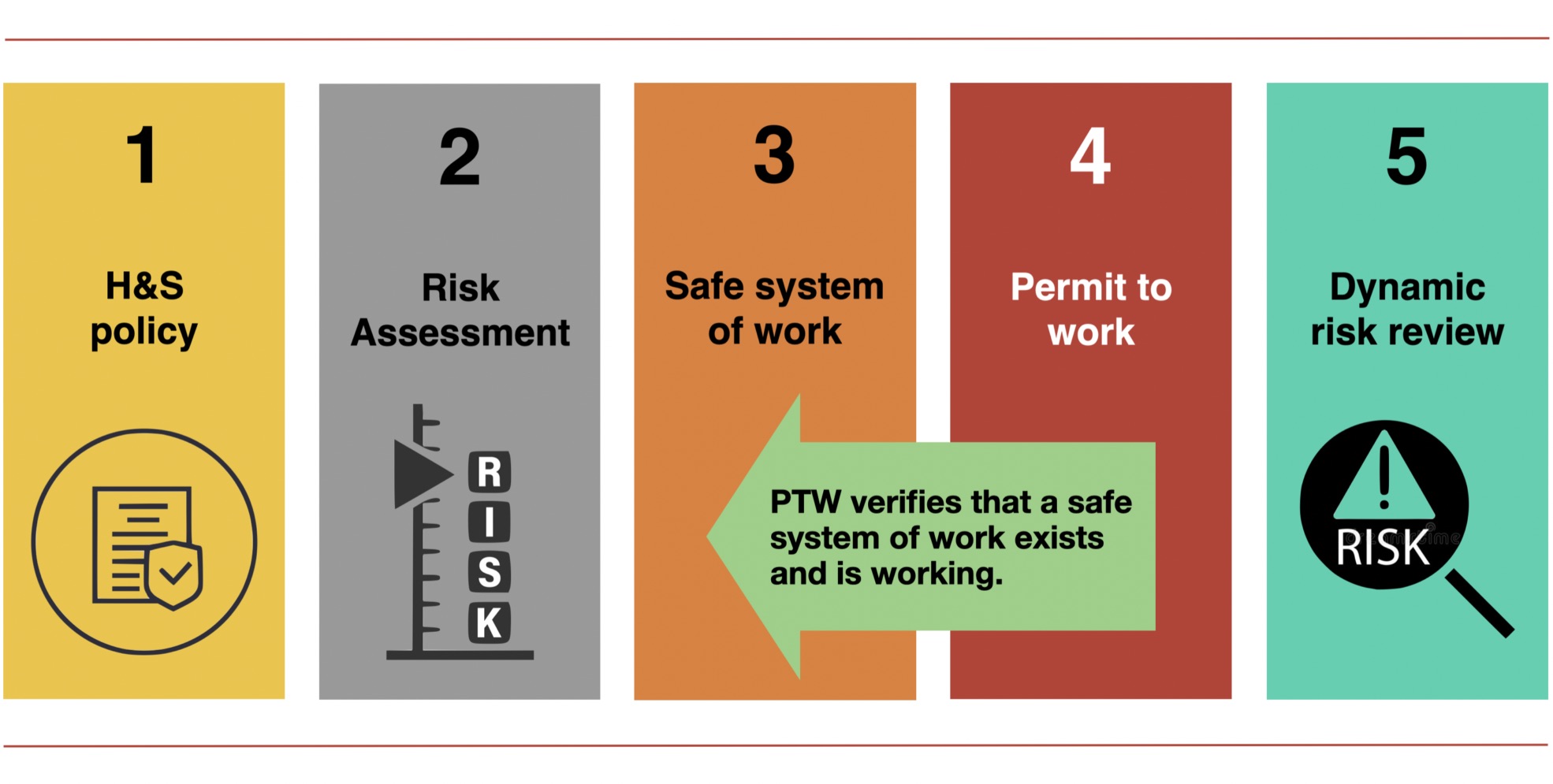
A Permit to Work must never be used in isolation from other formal control processes. In particular, it must operate alongside:
- Organisational policy arrangements Required by law, and essential to defining authority and accountability.
- Risk assessment Both general and task-specific risk assessments are legal requirements.
- Safe systems of work Any task requiring a Permit to Work must already have a defined safe system of work. The permit exists to ensure it is functioning as intended.
- Before-work job checks Dynamic checks carried out by workers or teams to confirm conditions have not changed.
Together, these elements form the overall safe system of work, particularly for tasks with a high consequence of failure.
Monitoring, assurance and review
Most Permit to Work systems do not fail suddenly. They fail through drift. A competent system includes arrangements for:
- monitoring live permits in the field
- sampling completed permits for quality and effectiveness
- learning from deviations, near misses and incidents
- auditing both compliance and system design
- reviewing and improving policy, procedures, forms and training
Without this feedback loop, PTW systems slowly become ritualised, even though the paperwork continues.
Legal status and consequences
Permit to Work policies and arrangements exist to give effect to statutory duties to protect health, safety and welfare.
In the UK, these duties arise principally from the Health and Safety at Work etc. Act 1974 and the Management of Health and Safety at Work Regulations 1999.
Where a Permit to Work system has been established to discharge those duties, it must be followed. Failure to do so has consequences for organisations, senior officers and employees alike.
More importantly, it removes a critical layer of protection from high-risk work.
Frequently Asked Questions
What are the three documented components of a permit to work system?
A competent permit to work system rests on three connected documents: the policy and arrangements that set authority and the rules for how the system operates; the procedures that translate that policy into repeatable operational practice; and the permit form itself, which records the specific task-level controls and authorisations. None of these works in isolation. A well-designed form cannot compensate for weak governance. A policy without procedures is unenforceable. Procedures without competent people are bypassed in practice.
What should a permit to work policy include?
A permit to work policy should define when permits are required and when they are not, who has authority to approve, issue, suspend, and cancel permits, the competence requirements for permit issuers and receivers, the interfaces with other control processes (risk assessment, isolation and energy control, contractor management, emergency arrangements), and how the system is monitored, audited, and reviewed. The policy is the rule set that gives the system legal and managerial force. Without clear policy arrangements, permits become optional paperwork rather than mandatory controls.
Are permit to work systems legally required in the UK?
There is no UK statute that specifically mandates a permit to work system. The duty to operate one arises indirectly from the general duty under the Health and Safety at Work etc. Act 1974 to ensure health and safety so far as is reasonably practicable, and from the Management of Health and Safety at Work Regulations 1999 obligation to put suitable control measures in place for significant risks. Topic-specific regulations (Confined Spaces 1997, Electricity at Work 1989, Diving at Work 1997) impose more specific duties for particular hazardous activities. Where a permit to work system has been established to discharge those duties, it must be followed.
What is the difference between a permit to work policy and a permit to work procedure?
The policy sets the rules – when permits are required, who has authority, what competence is needed, how the system is governed. The procedure describes the practical operation – how a permit is requested, issued, handed over between shifts, suspended, cancelled, and closed out. The policy is strategic; the procedure is operational. Both are needed. Policy without procedures is unenforceable in the field; procedures without policy lack the authority to require compliance.
Does the permit form itself create safety control?
No. The permit form records that control exists and that the necessary precautions have been verified – it does not, by itself, create the control. A permit signed over inadequate isolation, untrained workers, or unverified conditions documents an assertion, not a safe condition. Where the form is treated as the thing that makes work safe, the permit system has lost its function: it is producing paperwork while the controls it claims to record may or may not exist. Competent permit to work management is the continuous verification that the controls the system documents are the controls that actually exist.
How should organisations monitor whether a permit to work system is working?
Effective monitoring includes live observation of permits in the field (not just review of completed forms), periodic sampling of completed permits to assess quality, structured learning from deviations and near misses, audit of both compliance and system design, and regular review of the policy, procedures, and forms against current operations. Most permit to work systems fail through drift rather than sudden collapse small accommodations to operational pressure accumulate, individually unremarkable, until the controls the system documents are no longer the controls that exist. The monitoring arrangements are what detect drift before it produces an incident.