Permit to Work · Knowledge Hub · Page 4 of 9
Types of Permit to Work
The different permit types used in industry – from hot work and confined space to general work permits – and how they fit together as a system.
Verification · Coordination · Control
Why Separate Permit Types of Permit to Work Exist
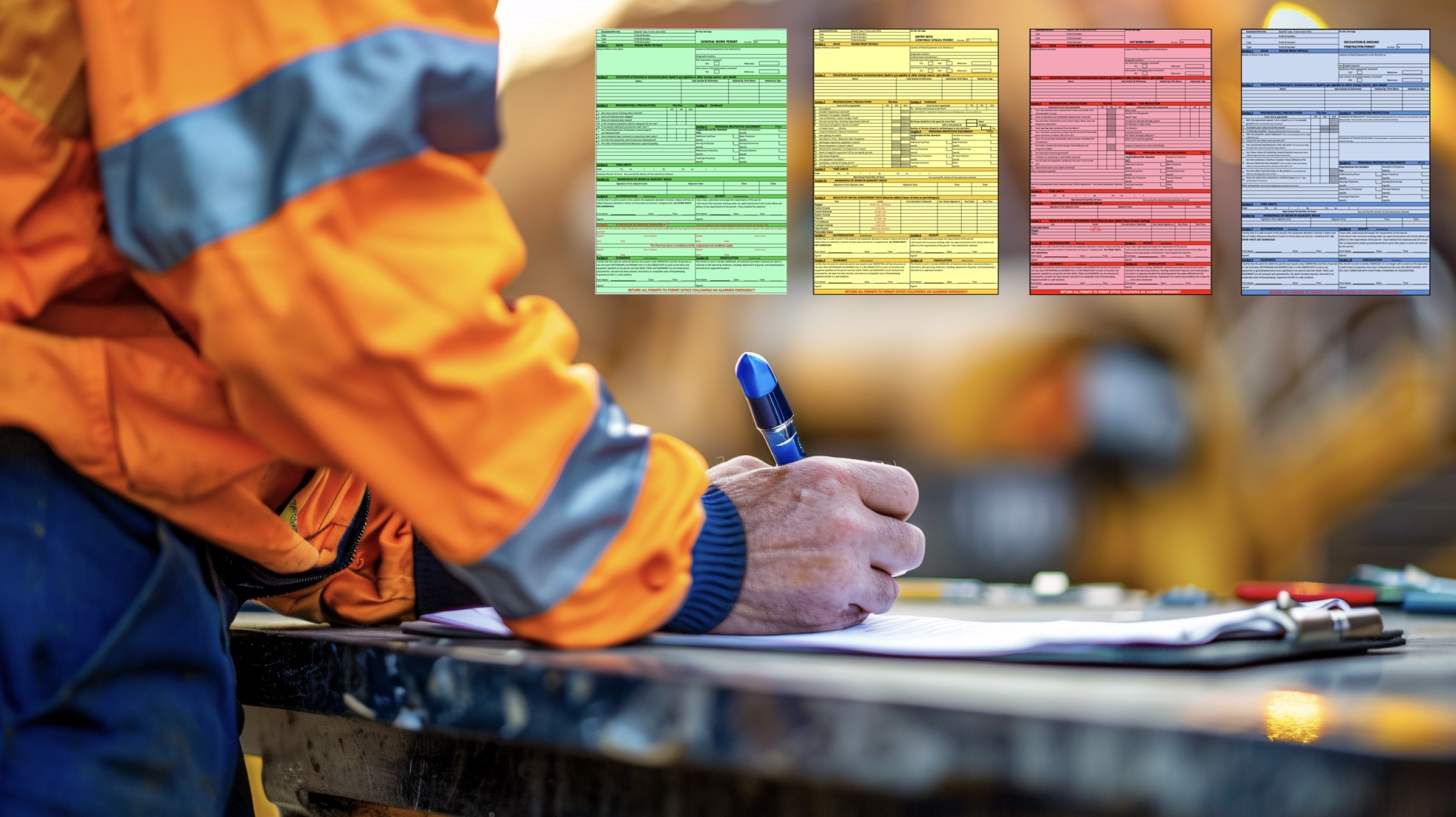
The types of permit to work used in industry exist for one reason. To ensure the right checks are applied to the right hazards before work begins. A permit to work is a verification document, not a generic form. Its value lies in prompting controls that are specific to the work being carried out.
A single form that attempts to cover every hazard will either become so long it is unusable, or so broad that it misses the controls that matter. Separate types of permit to work resolve this by focusing on defined hazard categories and ensuring that critical checks are not overlooked.
A permit to work is a verification document. Its value lies in prompting the right checks for a specific set of hazards before work begins. A generic form that tries to cover every possible hazard type will inevitably either become so long as to be unusable, or so vague as to miss the specific controls that matter for any given task.
Separate permit types solve this problem. A hot work permit prompts checks specifically relevant to ignition sources and flammable materials. A confined space permit prompts atmospheric testing, rescue arrangements, and standby person requirements. An electrical permit prompts isolation verification and proving dead procedures. Each form is designed around the specific hazard profile of that work category.
Understanding when a permit to work is required – and when it is not – is the first step. Once that threshold is met, the question becomes which permit type applies.
HSG250 does not prescribe a specific list of permit types that all organisations must use. It requires that the permit system is appropriate to the hazards present. An organisation that never carries out hot work does not need a hot work permit. One whose operations involve regular excavation work near buried services needs a ground penetration permit as a matter of course.
The principle: The permit types an organisation uses should reflect its actual hazard profile; not a standardised list adopted from a textbook or another industry’s practice. Most organisations use a small number of permit types consistently. The ones they use should be the ones that matter for their work.
The Main Permit Types
The following types of permit to work types appear consistently across UK industry and are reflected in HSG250 and sector-specific guidance. Each card indicates how universally applicable the type tends to be across different sectors and organisation sizes.
Each permit type exists to prompt the specific verifications that matter for that category of work – not generic checks, but hazard-specific controls. The following permit types appear consistently across UK industry and are reflected in HSG250 and sector-specific guidance
Hot Work Permit
Controls any work involving a source of ignition — welding, cutting, grinding, brazing, open flame — in areas where flammable materials, gases, vapours, or dusts may be present.
The most universally common permit type across all industries. Ignition sources are present in almost every maintenance environment and the consequences of an uncontrolled ignition can be catastrophic. A sugar mill, a hospital boiler room, a petrochemical plant — the hot work permit is the first permit type most organisations establish.
UniversalConfined Space Entry Permit
Controls entry into any enclosed or partially enclosed space where there is a foreseeable specified risk — atmospheric hazards, engulfment, loss of consciousness, or drowning.
The Confined Spaces Regulations 1997 impose specific legal requirements for confined space work. The permit must address atmospheric testing, means of communication, rescue arrangements, and the appointment of a standby person outside the space. No other permit type carries quite the same immediate life-safety stakes.
UniversalElectrical Work Permit
Controls work on or near electrical systems, live conductors, switchgear, and distribution equipment. In many organisations this operates alongside or is replaced by a formal Electrical Isolation Certificate or Sanction for Test.
The Electricity at Work Regulations 1989 require that work on electrical systems is properly controlled. High-voltage systems typically require additional formal documentation. Many organisations with large electrical infrastructure operate a separate Authorised Person system for electrical work specifically.
CommonGround Penetration Permit
Controls any excavation, drilling, or penetration of external ground or internal floors where buried services — gas, electricity, water, telecoms, drainage — may be present.
Striking a buried gas main or live electrical cable during excavation is a consistent cause of serious injury and death. The permit requires confirmation of service drawings, CAT scanning, and hand-digging near identified services. Applies to both hard and soft surfaces, internal and external locations.
CommonRoof Work Permit
Controls work on pitched roofs, fragile surfaces, or work involving the integrity of edge protection, access arrangements, or roof-level structures.
Falls from height remain one of the most common causes of workplace fatality in the UK. Roof work permits ensure that access arrangements are in place and verified, fragile surfaces are identified, and edge protection is confirmed before anyone sets foot on the roof. Not typically required for flat roofs with safe access and adequate edge protection.
CommonCold Work Permit
Used in process industries and offshore operations to control non-routine maintenance work that does not involve ignition sources but still requires formal authorisation — intrusive maintenance, breaking into pipework, work on pressurised systems.
Particularly common in oil, gas, and chemical sectors where the distinction between hot and cold work has specific process safety significance. In many other sectors, this function is fulfilled by the General Work Permit.
Process & OffshoreThe General Work Permit
The General Work Permit sometimes called a Cold Work Permit, Routine Maintenance Permit, or simply a Work Permit is the catch-all permit type. It covers hazardous tasks that do not fall within a specific permit category but where risk assessment has determined that formal authorisation and verification is required.
Typical applications include lifting manhole covers in traffic routes, work in proximity to live services without penetrating ground, complex multi-trade maintenance tasks, work on plant where energy isolation is required but no hot work is involved, and tasks that require coordination between multiple contractors or departments.
The General Work Permit is valuable precisely because hazardous work does not always fit neatly into a specific category. It provides a formal control mechanism for the genuinely hazardous tasks that fall in the gaps between the specialist permit types.
The risk with the General Work Permit is that it can become a dumping ground — applied to tasks that would be better controlled by a specific permit type, or equally applied to tasks that do not genuinely require a permit at all. Its use should always be driven by risk assessment, not administrative convenience.
In organisations with a limited hazard profile, the General Work Permit may be the primary or only permit type in regular use. In complex industrial environments, it operates alongside specialist permits, covering the work that sits outside their specific scope.
Radiography Permit
Controls the use of radioactive sources or X-ray equipment for non-destructive testing of welds, pipework, and structures. Requires formal area designation, exclusion zone management, and radiation protection supervision.
Industrial NDTPipeline / Line Breaking Permit
Controls the breaking into of pipelines or process systems containing hazardous substances. Requires confirmation of isolation, depressurisation, and purging before any joint or fitting is opened.
Process & Oil/GasPressure Systems Permit
Controls maintenance and inspection work on pressure vessels, boilers, and associated pipework. Requires formal isolation and depressurisation verification before work begins.
Process IndustriesDiving Permit
Controls underwater work on structures, pipelines, and vessels. Heavily regulated under the Diving at Work Regulations 1997. Common in offshore, port, and civil engineering environments.
Offshore & MarineNaming Conventions Across Industry
One of the first things that becomes apparent when working across different organisations and sectors is that the same permit type often goes by different names. This is not a problem with the systems it is simply a reflection of the fact that there is no nationally or internationally mandated terminology for permit types. HSG250 describes what permit systems should achieve; it does not prescribe what each permit should be called.
The following table illustrates how the same permit function appears under different names across industries and organisations:
| Function | Common names used across industry |
|---|---|
| Work involving ignition sources | Hot Work Permit, Hot Work Certificate, Fire Permit, Ignition Work Permit |
| General hazardous maintenance | General Work Permit, Cold Work Permit, Work Permit, Routine Maintenance Permit, Safe Work Permit |
| Enclosed space entry | Confined Space Permit, Entry Permit, Confined Space Entry Certificate, Enclosed Space Permit |
| Electrical system work | Electrical Permit, Permit to Test, Sanction for Test, Electrical Isolation Certificate, High Voltage Permit |
| Ground or floor penetration | Ground Penetration Permit, Excavation Permit, Digging Permit, Breaking Ground Permit |
| Roof and height work | Roof Work Permit, Working at Height Permit, Rooftop Access Permit |
| Breaking into process pipework | Line Breaking Permit, Pipeline Permit, Intrusive Maintenance Permit, Breaking Containment Permit |
When a worker moves between organisations or sites as contractors frequently do encountering a different permit name for a familiar function is normal. What matters is that the permit’s purpose and requirements are clearly understood, whatever it is called. Competent training should equip workers to recognise the function of a permit from its content, not just its label.
Format and Medium
Permit to work documents have been produced in a variety of formats since the earliest paper-based systems, and the range has expanded further with the adoption of electronic systems. The format used has practical implications for how the permit system operates how permits are stored, how concurrent permits are managed, and how the audit trail is maintained.
Pre-printed Book
Bound books of permits, often carbonless duplicate or triplicate sets. One copy retained at the permit office, one with the work party. Traditional and widely used in industrial environments. Physical and auditable.
A4 Single Sheet
Individual permit forms, printed on demand or pre-printed in batches. Flexible and easy to update when procedures change. Common in organisations with lower permit volumes.
A3 Format
Larger format permits used where the document needs to accommodate multiple sections, isolation registers, or certificates within a single document. Common in complex process environments.
Carbonless Sets
Multi-part forms producing simultaneous copies without carbon paper. Allows distribution of copies to permit office, issuer, and receiver at point of issue. Standard in many industrial operations.
Electronic Systems
Software-based permit management platforms. Enable centralised visibility of active permits, enforce mandatory fields, automate approval routing, and generate searchable audit records. Increasingly common in larger operations.
Hybrid Systems
Paper permits managed through an electronic tracking system. Combines the familiarity and field practicality of paper forms with centralised digital logging, visibility, and audit trails. Increasingly common as a transitional approach.
Format does not determine effectiveness. A well-designed paper system rigorously applied will outperform a poorly operated electronic one. The value of any permit format lies in the discipline with which it is used — not the technology that delivers it.
Format does not determine effectiveness. A well-designed paper system rigorously applied will outperform a poorly operated electronic one.
Permit to Work vs Certificate of Isolation
One of the most common sources of confusion in permit to work practice is the relationship between the permit itself and a Certificate of Isolation sometimes called an Isolation Certificate, a Lock-out Tag-out record, or an Energy Isolation Certificate.
These are related but distinct documents with different purposes, and understanding the difference matters practically.
Authorises a defined scope of work on specified plant or equipment. Confirms that identified hazards have been assessed, precautions are in place, and the work party has formally accepted responsibility for safe working. The permit defines what work may be done, where, by whom, and under what conditions.
Documents the specific isolation measures applied to make plant or equipment safe for work. Records which energy sources have been isolated, how, and by whom. The isolation certificate verifies that the plant is safe to work on before the permit is issued.
The permit authorises the work. The isolation certificate records the physical measures that make it safe to carry out. Both are required for maintenance work on energised or potentially energised systems but they serve different functions and should not be confused or conflated.
In some organisations, isolation information is recorded within the permit form itself. In others, it is a separate attached document. Either approach can work well. What matters is that the isolation is formally recorded, independently verified, and clearly referenced in the permit.
Summary
Permit types exist because different hazards require different specific controls, and a single generic form cannot adequately prompt the right checks for every situation. Understanding what a PTW system actually is – and what it is not – provides the foundation for selecting and applying the right permit type. The types an organisation uses should reflect its actual hazard profile most organisations work consistently with a small number of permit types rather than an exhaustive catalogue.
Hot work is the most universally common permit type across all industries. Confined space and electrical permits are similarly widespread. Ground penetration, roof work, and general work permits are common in estates, construction, and facilities management environments. Sector-specific types – radiography, line breaking, diving apply where those specific hazards are present.
Naming varies across industry and sector. The same function may be called by different names in different organisations. What matters is that the permit’s purpose is understood, not what it is called.
Format – paper, electronic, or hybrid – does not determine effectiveness. The permit system works when the people operating it understand what it is for and apply it with genuine rigour. Where permit types are applied without genuine understanding, predictable failure modes emerge.
Our PTW training course covers all major permit types and develops practical competency for issuers and receivers.
Frequently Asked Questions
What are the main types of permit to work?
The main types of permit to work are hot work permits, confined space entry permits, electrical work permits, ground penetration permits, roof work permits, and general work permits. Sector-specific types include radiography permits, line breaking permits, and diving permits.
What is a hot work permit?
A hot work permit controls any work involving a source of ignition – welding, cutting, grinding, brazing, or open flame in areas where flammable materials, gases, vapours, or dusts may be present. It is the most universally common permit type across all industries.
What is a confined space entry permit?
A confined space entry permit controls entry into any enclosed or partially enclosed space where there is a foreseeable specified risk i.e. atmospheric hazards, engulfment, loss of consciousness, or drowning. The Confined Spaces Regulations 1997 impose specific legal requirements for this work.
What is a general work permit used for?
A general work permit covers hazardous tasks that do not fall within a specific permit category but where risk assessment has determined that formal authorisation is required. Examples include lifting manhole covers in traffic routes, complex multi-trade maintenance, and work requiring energy isolation without hot work
Why do different organisations use different permit names?
There is no nationally mandated terminology for permit types. HSG250 describes what permit systems should achieve, not what each permit should be called. The same function, such as hot work control may be called Hot Work Permit, Fire Permit, or Ignition Work Permit in different organisations.
What is the difference between a permit to work and an isolation certificate?
A permit to work authorises a defined scope of work and confirms that precautions are in place. An isolation certificate documents the specific isolation measures applied to make plant or equipment safe which energy sources have been isolated, how, and by whom. Both are required for work on energised systems but serve different functions.
How many types of permit does an organisation need?
The types of permit to work an organisation uses should reflect its actual hazard profile. Most organisations work consistently with a small number of permit types, thats typically 3-6 rather than an exhaustive catalogue. An organisation that never does hot work doesn’t need a hot work permit.