Permit to Work · Knowledge Hub · Page 3 of 9
When Is a Permit to Work Required?
The legal and practical triggers for permit to work – and the common mistakes organisations make in deciding when PTW applies.
Verification · Coordination · Control

The Problem of PTW Overuse
When is a permit to work required? The Health and Safety Executive is explicit on this point. HSG250, the primary UK guidance on permit to work systems, warns directly against the overuse of permits. The guidance notes that applying a PTW to work that does not genuinely require one is not a neutral act, it actively undermines the system’s effectiveness. Where organisations treat permits as paperwork, predictable failure modes emerge – failure modes that have been documented repeatedly since Piper Alpha.
This matters because permit systems depend on the people operating them treating each permit as a genuinely meaningful act of verification. When permits are issued for low-risk routine tasks alongside genuinely hazardous high-consequence work, two things happen. The administrative burden grows to a point where careful attention to every permit becomes impossible. And the culture around permits shifts from serious engagement to routine form-filling, which is precisely the condition in which permit systems fail.
Getting the threshold right issuing permits where they are genuinely required and not issuing them where they are not is one of the most important judgements in managing a permit system. It requires clear organisational policy, competent decision-makers, and a shared understanding of what the permit system is actually for.
What Actually Triggers a PTW Requirement
When is a permit to work required? A permit to work is required when two conditions are both present: the work is hazardous, and the consequences of a failure in control are severe. HSG250 frames this in terms of work where there is a foreseeable risk of serious injury or death, and where routine supervision or standard operating procedures are insufficient to manage that risk reliably.
This framing is important. It is not enough for work to be hazardous in a general sense. Most maintenance, cleaning and operational work carries some degree of hazard. The PTW threshold is specifically concerned with work where a single failure a pump started prematurely, an isolation removed without warning, a gas test not carried out could kill or seriously injure someone.
The second element, that routine supervision or standard procedures are insufficient is equally important. Where a clearly defined safe operating procedure, properly followed by competent people under adequate supervision, provides reliable control of the risks involved, a permit to work may not be necessary. The permit adds value where there is a need for formal, documented authorisation, isolation, and verification beyond what routine procedures provide.
The PTW test in plain terms: Would a failure of control at any point in this task be likely to result in death or serious injury? And is that risk one that cannot be adequately managed through standard procedures and routine supervision alone? If the answer to both questions is yes, a PTW is likely required.
Work That Always Requires a PTW
Most PTW policies identify a defined set of work types for which a permit is always required, regardless of the circumstances or the perceived experience of those carrying out the work. These are activities where the hazard profile is sufficiently consistent and severe that organisational policy mandates formal control in all cases.
The specific list varies between organisations and sectors, but the following categories appear consistently across UK industry and are reflected in HSG250 and sector-specific guidance:
Hot Work
Any work involving a source of ignition; welding, cutting, grinding, brazing, or use of open flame; in areas where flammable materials, gases, vapours, or dusts may be present.
Confined Space Entry
Entry into any enclosed or partially enclosed space where there is a foreseeable risk of serious injury from hazardous substances, lack of oxygen, engulfment, or other specified risks.
Electrical Work
Live electrical work, work on or near exposed conductors, and work on high-voltage systems. The Electricity at Work Regulations 1989 underpin the requirement for formal control of electrical work activities.
Work at Height on Roofs
Work on pitched roofs, fragile surfaces, or involving the integrity of edge protection or access arrangements. Specific roof work permits are used in many organisations to address these hazards.
Ground Penetration
Excavation, drilling, or any penetration of external ground or internal floors where services; gas, electricity, water, telecoms; may be present below the surface.
Intrusive Maintenance
Work that requires breaking into systems containing hazardous substances under pressure, or opening up plant where hazardous energy sources may be released if not properly isolated.
Work on Energised Systems
Any maintenance, inspection or modification work on systems where chemical, electrical, hydraulic, pneumatic, steam, pressure or gravitational energy could cause harm if not controlled.
Radiation Work
Work involving radioactive sources, radiography, or ionising radiation in environments where exposure control requires formal authorisation and verification beyond routine procedures.
General Work Permit
Used for hazardous tasks that do not fall within a specific permit category but where risk assessment determines formal authorisation is required. Examples include lifting of manhole covers in traffic routes, work in proximity to live services, and complex multi-trade maintenance tasks.
The principle behind defining mandatory PTW categories in organisational policy is that it removes the need for a case-by-case judgement on every occasion. Where hot work is always a PTW activity, there is no room for a supervisor to decide on a particular day that the job is straightforward enough not to bother. The policy removes that discretion at the point where discretion is most dangerous.
The different types of permit – hot work, confined space, electrical, excavation, exist because different hazards require different specific controls.
When Risk Assessment Determines the Need
Beyond the mandatory categories, PTW policy typically provides for permits to be required wherever a suitable and sufficient risk assessment of a specific task identifies that the hazards involved warrant formal authorisation and verification.
This risk assessment-led trigger is important for two reasons. First, it ensures that the PTW system can respond to work types that fall outside the standard categories but nonetheless present high-consequence risks in specific circumstances. Second, it places responsibility on competent people those conducting risk assessments and those authorising work to apply professional judgement rather than simply ticking boxes.
In practice, this means that a piece of maintenance work that would not ordinarily require a permit might require one in a particular context because of the location, the proximity to other work, the condition of the plant, or the particular hazards present at that time. The risk assessment is the mechanism for identifying and acting on that context.
Contractor work
Many organisations apply PTW requirements to all work carried out by contractors, or at minimum to all contractor work involving the hazard categories identified above. This reflects the recognition that contractors may be unfamiliar with site-specific hazards, that interface risks between contractor activities and host site operations require formal management, and that the permit provides a documented communication mechanism between the issuing authority and the contractor’s workforce.
It is worth noting, however, the distinction drawn on this page on PTW and contractors: a permit is not a substitute for competent contractor management. It verifies that controls are in place. It does not create those controls, and it does not compensate for weak contractor selection, induction, or supervision. Permit to work does not replace a system, see example below:
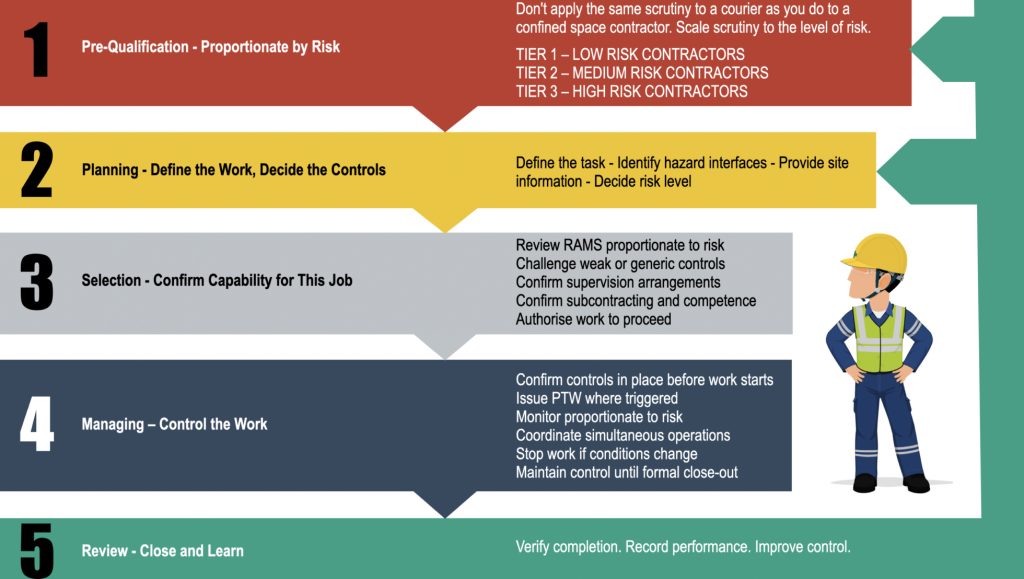
A permit to work can only verify that controls exist. It cannot create them. Where contractor management arrangements are weak, no permit system can compensate. Our Managing Contractor Training covers the complete five-step framework for controlling high-risk contractor work effectively.
When a PTW Is Not Required
HSG250 is clear that permit to work systems should not be applied to routine operations that are adequately controlled by other means. Understanding where the boundary sits is as operationally important as knowing when permits are needed.
- High-consequence hazards present
- Multiple parties or shifts involved
- Formal isolation required and must be verified
- Work in confined spaces or at height on roofs
- Hot work near flammable materials
- Live electrical or pressure systems
- Ground or floor penetration
- Concurrent activities creating interaction hazards
- Contractor work on high-risk activities
- Work where failure could be immediately fatal
- Routine operational tasks with defined SOPs
- Low-risk maintenance with standard precautions
- Work adequately controlled by method statement alone
- Inspection activities with no physical intervention
- Administrative or office-based work
- Work where hazards are minor and reversible
- Tasks covered by simpler, proportionate controls
- Repetitive routine tasks by competent, familiar workers
One of the most widespread errors in permit to work management is treating the PTW as the default response to any task that carries some level of hazard. This is not what the system is designed for. Where a well-written safe operating procedure, followed by trained and supervised workers, provides adequate control of a task, that is the appropriate control measure; not a permit.
Applying a PTW to such tasks does not add safety. It adds paperwork, consumes issuer time and attention, and degrades the signal value of permits across the entire system.
Making the Decision: A Practical Framework
When is a permit to work required for a specific task? The decision should follow a structured thought process. The following framework reflects the approach embedded in competent PTW policies and is consistent with HSG250 guidance
Is this a mandatory PTW category?
Check the organisation’s PTW policy. If the work type is listed as always requiring a permit; hot work, confined space entry, electrical work, ground penetration, etc.; the decision is made. Issue a permit.
Conduct a suitable and sufficient risk assessment
For work not covered by mandatory categories, assess the specific hazards of the task. Consider the energy sources involved, the consequences of a failure of control, the proximity to other work, and the competence of those involved.
Apply the PTW test
Could a failure of control at any stage result in death or serious injury? Are the hazards such that standard procedures and routine supervision are insufficient? If yes to both, a PTW is required.
Consider the context
Even where a task would not ordinarily require a permit, consider whether specific contextual factors; proximity to live systems, concurrent activities, contractor involvement, shutdown conditions; elevate the risk to PTW threshold.
If not a PTW, what is the appropriate control?
Where a PTW is not required, identify and implement the appropriate control measure; a safe operating procedure, method statement, toolbox talk, or other proportionate mechanism. The absence of a permit does not mean the absence of control.
Record the decision
Where a decision has been made that a PTW is not required for a task that could be considered borderline, document the reasoning. This provides an audit trail and reinforces the discipline of the decision-making process.
Organisational vs Task-Level Decisions
There are two distinct levels at which PTW threshold decisions are made, and it is important to understand the difference between them.
Organisational level
At the organisational level, PTW policy defines the mandatory categories the work types for which a permit is always required. This is a strategic decision made by those responsible for designing the PTW system, based on a considered assessment of the hazard profile of the organisation’s activities. These decisions are documented in the PTW policy and should not be subject to case-by-case override by operational managers or supervisors.
Task level
At the task level, competent permit issuers and those conducting risk assessments make judgements about whether specific tasks outside the mandatory categories require a permit. These judgements should be informed by the risk assessment, by the specific context of the work, and by a clear understanding of what the PTW system is designed to achieve.
The risk at the task level is in both directions. An issuer who defaults to issuing permits for everything to avoid the responsibility of making a judgement contributes to overuse and system degradation. An issuer who routinely decides that nothing outside the mandatory categories requires a permit misses the genuine cases where contextual factors elevate risk to PTW threshold.
Both failure modes require the same remedy: competent people with a genuine understanding of the system’s purpose, operating within a clear policy framework, and supported by adequate training and management oversight.
Summary
When is a permit to work required? When work involves hazards where a failure of control could cause death or serious injury, and where those hazards cannot be adequately managed through standard procedures and routine supervision. It is not required for every hazardous task, and applying it indiscriminately undermines the system it is meant to support.
Understanding what a PTW system actually is, and what it is not is the foundation for making sound decisions about when one is required. Our PTW training course develops this understanding into practical competency for issuers, receivers, and system managers
The Key Principles are:
- Define mandatory categories in policy – hot work, confined space, electrical work, ground penetration and similar activities should always require a PTW, removing the need for case-by-case judgement on these tasks.
- Use risk assessment for everything else – where a task is not a mandatory category, a suitable and sufficient risk assessment determines whether a PTW is needed.
- Resist the default to overuse – a PTW is not the appropriate response to every task that carries some hazard. Proportionate control measures exist for lower-risk work.
- Context matters – a task that would not normally require a permit may require one in specific circumstances. Competent issuers need to recognise and respond to those circumstances.
- No permit does not mean no control – where a PTW is not required, an appropriate alternative control measure must still be in place. The question is never permit or nothing.
PTW Frequently asked questions
When is a permit to work required by law?
here is no single UK regulation that prescribes “a permit to work” in the abstract. However, the Health and Safety at Work Act 1974, the Management of Health and Safety at Work Regulations 1999, and sector-specific regulations create circumstances where a formal PTW system is the only practicable way to meet the statutory duty. HSG250 provides the authoritative guidance on when a permit is required.
Is a permit to work required for all contractor work?
Not necessarily. Many organisations require permits for all contractor work involving high-hazard activities, but a permit is not a substitute for competent contractor management. The permit verifies that controls are in place, it does not create them. Low-risk contractor work may be adequately controlled through method statements and supervision alone.
When is a permit to work required for hot work?
Hot work – welding, cutting, grinding, or any activity involving ignition sources should always require a permit when carried out in areas where flammable materials, gases, vapours, or dusts may be present. Most organisations define hot work as a mandatory PTW category in their policy
Is a permit required for every hazardous task?
HSG250 is explicit that permits should not be used for routine operations adequately controlled by other means. Overuse of permits dilutes their significance and trains people to treat the system as paperwork. The PTW threshold is work where a failure of control could cause death or serious injury.
Who decides when a permit to work is required?
Two levels of decision apply. At the organisational level, PTW policy defines mandatory categories work types that always require a permit. At the task level, competent permit issuers and those conducting risk assessments judge whether specific tasks outside mandatory categories require a permit based on the hazards and context.
What happens if work is done without a required permit?
Working without a required permit is a serious breach of safety management. It removes the formal verification that hazards have been assessed and controls are in place. In the event of an incident, the absence of a permit where one was required would be a significant factor in any investigation and potential prosecution.