

The concept has appeal. The question is whether it holds up where it matters most.
The idea of marginal gains has been circulating in safety leadership circles for a while now, and recent discussion on LinkedIn prompted me to look at it more carefully. It deserves a serious appraisal rather than a reactive one. This is an attempt to do that.
Where the Concept Comes From
The aggregation of marginal gains originates with Dave Brailsford, Performance Director of British Cycling from 2003. His philosophy was straightforward: break down everything that goes into riding a bike, improve each element by 1%, and the cumulative effect is transformational.
The results are well documented. Between 2007 and 2017, British cyclists won 178 world championships, 66 Olympic or Paralympic gold medals, and five Tour de France victories. Before Brailsford’s tenure, British cycling had won a single Olympic gold medal in 76 years.
James Clear popularised the concept further in Atomic Habits, one of the bestselling books of the past decade, and it has since become a staple of leadership and performance improvement across business, healthcare, sport, and personal development.
Its application to safety management follows the same logic: make work a little safer every day through better leadership behaviours, improved conversations, greater attention to weak signals, and stronger routines. Small improvements accumulate. Progress compounds. Over time, the result is significant harm reduction.
It is an appealing proposition. Before accepting or rejecting it, it is worth being precise about what made the original concept work because the conditions matter enormously.
What Actually Made Marginal Gains Work
Brailsford’s approach wasn’t motivational. It was operational and forensic.
Every claimed gain was identified, measured, and tested. Power output was monitored with biofeedback sensors. Fabric performance was assessed in wind tunnels. Recovery protocols were timed and analysed. The team tested different massage gels to identify which produced the fastest muscle recovery. They hired a surgeon to teach athletes the optimal hand-washing technique to reduce illness rates. The mechanics’ truck floor was painted white not as a metaphor, but as a practical measure to identify contamination affecting mechanical performance.
Every 1% gain was a 1% gain in something specific and measurable. There was a baseline, a method of verification, and a demonstrable result. The measurement was not incidental to the method. It was the method.
It’s also worth noting that not everyone who lived through it agrees on what drove the success. Bradley Wiggins, who won the Tour de France under this philosophy, subsequently described the marginal gains strategy as “a load of rubbish,” attributing results instead to hard work and talent. Independent analysis has pointed to significantly increased funding, improved coaching infrastructure, and applied sports science as substantial contributing factors suggesting the marginal gains narrative, while compelling, was only part of the story.
Finally, and critically: British Cycling was already operating at an elite level. The marginal gains philosophy was applied to extract the last competitive fraction from an already high-performing system. The athletes were world class. The systems were functioning. The question was how to get fractionally better at everything.
These conditions high baseline, rigorous measurement, already-functioning systems are not incidental to whether the concept works. They are the conditions under which it works.
The Transfer to Safety Management

When marginal gains thinking moves into occupational safety, something essential is lost in translation.
The version that reaches boards and leadership teams typically sounds like this: make work a little safer every day through better conversations, more human leadership, greater attention to weak signals, and improved routines. Small improvements accumulate. Progress compounds.
This isn’t unreasonable as a description of continuous improvement in safety culture, engagement, or management behaviour. Those things matter. Incremental progress in leadership quality, reporting culture, and team communication is genuinely valuable, and nobody is arguing against getting better every day.
But this is not what Brailsford did. And in the transfer from cycling to safety, the measurement requirement the engine that made the original concept work has been quietly removed.
In practice: what is the baseline? What is being measured? How is a 1% improvement in safety verified? How does an organisation know whether it is moving in the right direction, standing still, or getting less safe while using the language of improvement?
“Brailsford measured everything. That was not a feature of the method. It was the method.”
These questions cannot be answered, because the concept as applied in safety management doesn’t require them to be answered. It is non-falsifiable. You cannot fail it. You cannot test whether it is working. It is not a metric, it is a narrative.
The Baseline Problem
Marginal gains philosophy assumes the system is already functioning well. The improvements Brailsford pursued were the last competitive fraction being extracted from an already optimised machine.
The evidence from regulatory enforcement suggests that for many organisations, the baseline is nowhere near that point.
In April 2026, Eurotunnel was fined £2.25 million following an incident at its Folkestone terminal in which a 115kg lighting carriage fell onto an engineering surveyor, causing multiple serious injuries. The Office of Rail and Road’s investigation found that staff had been winching equipment without appropriate training, there was no suitable safe system of work, no effective preventative maintenance of the lighting mast and its equipment, and no appropriate risk assessment for the specific task.
Richard Hines, HM Chief Inspector of Railways, described it as “a catalogue of entirely preventable maintenance and planning errors” and stated that it was “quite simply astonishing” that these basic controls had not been in place.
This was not a small employer or an under-resourced site. This was one of Europe’s busiest transport operators. The findings no risk assessment, no safe system of work, untrained staff are the same findings that appear repeatedly in HSE prosecution records across industries and years.
In these conditions, the question is not “how do we extract the last 1% from a finely tuned system?” The question is “do we have a functioning system in the first place?”
Presenting marginal gains thinking to an organisation that has not yet achieved reliable control of its significant risks implies a baseline that does not exist. It is a finishing coat being applied before the foundations have been laid.
The Threshold Problem
The most serious limitation of applying marginal gains thinking to occupational safety is the existence of threshold conditions.
In competitive cycling, there is no catastrophic floor. Getting 1% worse at recovery protocols produces a marginal deterioration in performance. You can correct course. The consequences are disappointing but recoverable.
In occupational safety, certain risks do not work that way. They are binary in their consequences.
The energy isolation is either adequate or it isn’t The permit to work is either correctly authorised or it is not. The worker is either competent for the task or they are not. The confined space atmosphere is either safe to enter or it is not. The control is either in place or it is not.
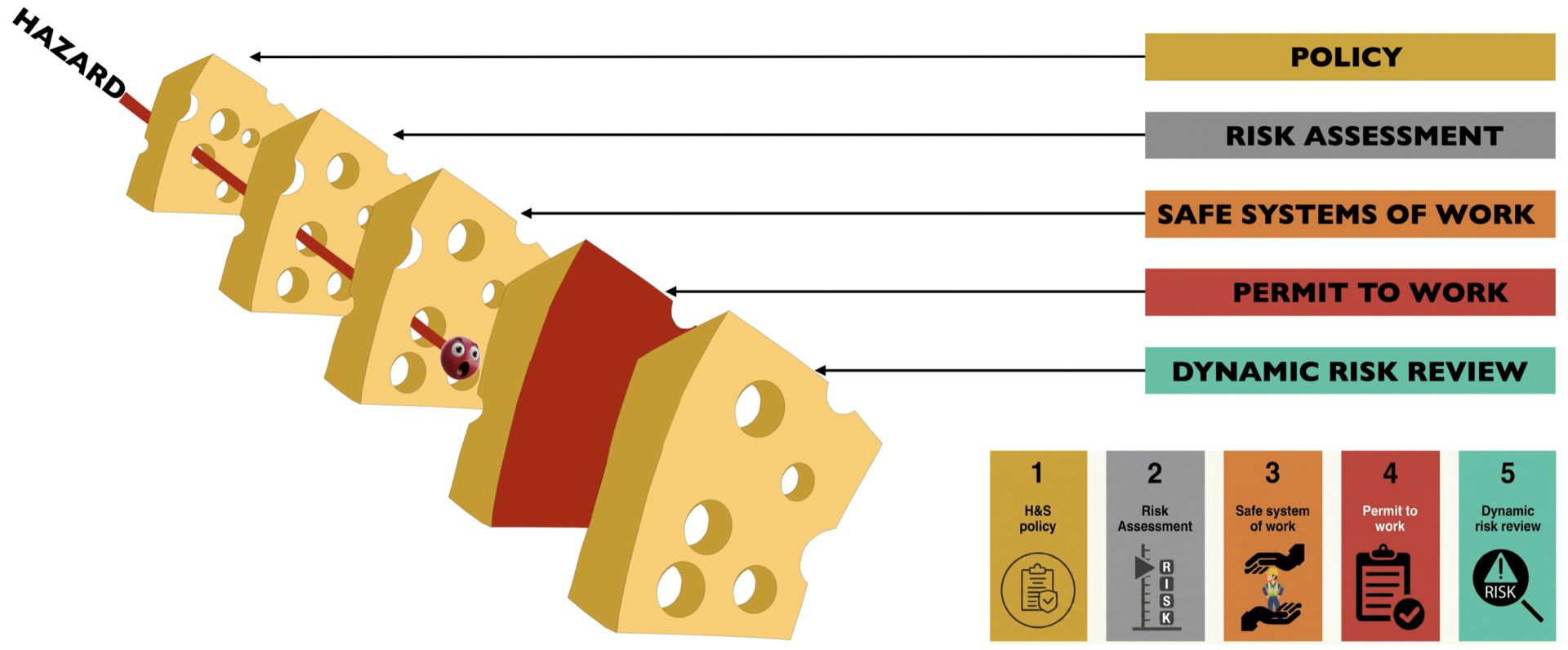
Below the control thresholds, the consequence is not a marginal deterioration. It’s serious injury or death.
No accumulation of 1% improvements in leadership conversations or daily routines will prevent an energisation incident caused by an inadequate isolation scheme. No marginal gain in communication substitutes for a competent person conducting a thorough dynamic risk assessment before confined space entry. These are not optimisation problems. They are threshold conditions. The appropriate response is not to nudge them incrementally it is to fix them properly.
The practical danger of presenting marginal gains as a general safety philosophy is that it gets applied indiscriminately both to areas where it has limited but genuine value, and to areas where it is simply the wrong tool.
A board committed to being “1% safer” has no way of knowing which it is doing. That ambiguity is not a minor limitation. It is the mechanism by which standards drift while confidence remains high.

What the Evidence Says
The research on what actually reduces injury rates in occupational settings is consistent, and it does not point to incremental improvement philosophy.
Cal/OSHA regulatory inspections in the United States produced a 9.4% reduction in injury claims and a 26% average saving on workers’ compensation costs in the four years following inspection compared to uninspected workplaces. The mechanism was identification and enforcement of specific control requirements. Standards. Verification. Accountability.
Occupational health and safety management systems ISO 45001 and its predecessor OHSAS 18001 show consistent associations with improved safety performance. The mechanism is systematic hazard identification, defined controls, monitoring, and management review. Again: defined. Controlled. Verified.
A seven-year study of a programme combining behaviour-based safety with traditional safety methods in a manufacturing environment recorded a 92% reduction in first-time occupational visits and a 99% reduction in lost-time case rates. The same study noted that organisations relying on approaches without structural rigour “will produce only marginal gains” using that phrase in its conventional sense of diminishing returns. The exact opposite of what the marginal gains philosophy promises.
The consistent finding is that injury reduction requires defined hazards, defined controls, and verified compliance. Not better conversations or daily improvement in undefined areas. Defined. Controlled. Verified.
Where 1% Thinking Sits – And Where It Stops
As a motivational idea, incremental improvement has intuitive appeal. Getting better every day, in any endeavour, is not a bad instinct.
But occupational safety is not a single endeavour. It contains two fundamentally different types of activity and the 1% framing only survives contact with one of them.
For non-risk activity culture development, leadership behaviour, reporting openness, communication quality incremental progress is legitimate. These are gradual, hard-to-measure dimensions that improve over time through sustained attention.
The moment the activity involves risk, the framing breaks down completely. Risk control is not a matter of gradual improvement. It is a matter of adequacy. The control either meets the standard or it does not. The system either works or it doesn’t. There is no 1% version of an isolation procedure. There is no marginal gain that substitutes for a missing risk assessment.
The difficulty is that safety leadership cannot be neatly partitioned. The same thinking that governs culture also governs decisions about controls. Leaders habituated to improvement language are less likely to ask the control question not because they are negligent, but because the framing they have been given does not prompt it.
That is where a motivational idea becomes a management liability.
The Measurement Gap
Perhaps the most significant gap between the original concept and its safety adaptation is measurement.
For Brailsford, measurement was not a feature of the method it was the method. Without knowing precisely what was improving and by how much, there is no way to distinguish genuine gains from wishful thinking, or to detect when something is quietly getting worse.
What would it take for “1%” to mean anything?
One way to make ‘1% safer’ meaningful would be to define a unit of risk and measure it. A micromort represents a one-in-a-million chance of death. In principle, you could establish a baseline risk for a task, implement a control, and demonstrate a reduction.
But the moment you introduce that level of definition and measurement, you are no longer using a slogan. You are doing structured risk assessment. And that’s the point.
The name ‘1% safer’ implies measurement. The content provides none.
Applied to safety without that requirement, marginal gains becomes a statement of intent with no mechanism of verification. An organisation can sincerely commit to daily improvement while its critical controls degrade, its risk assessments age without review, and its competence frameworks go unverified. The language of progress continues. The reality moves in the opposite direction.
This is not a theoretical risk. Organisational drift the gradual erosion of standards under operational and commercial pressure is a well-documented feature of major accident causation. It does not announce itself. It happens in the gap between what governance processes assume is happening and what is actually happening at the sharp end. A culture oriented around marginal improvement, rather than control verification, is less likely to detect it and may actively obscure it by providing reassurance that things are moving in the right direction.
“In the event of a serious incident, no regulatory investigation, coroner’s inquest, or criminal prosecution will accept evidence of cultural improvement as a substitute for the absence of a safe system of work. The Health and Safety at Work Act requires adequate controls. It does not grade on intent.”
Conclusion
The aggregation of marginal gains is an intellectually coherent concept with a legitimate performance improvement pedigree. In the right conditions a high-performing baseline, rigorous measurement of every claimed gain, and a domain without catastrophic threshold conditions it has demonstrable value.
Occupational safety management, in the majority of organisations that have not yet achieved reliable control of their significant risks, does not meet those conditions.
Where marginal gains thinking has been adapted for safety leadership it has retained the language and appeal of the original while discarding the measurement requirement that gave it validity. The result is a framework that is motivationally appealing, easily communicated, and practically unverifiable.
A safety improvement that can be claimed without being measured, and that cannot fail because it sets no falsifiable standard, is not a management tool. It is a comfort.
The question every organisation needs to answer before asking “how do we get 1% safer today?” is a prior one: do we know what our significant risks are, do we have adequate controls in place, and can we verify that those controls are working?
If the answer to those questions is yes then marginal gains thinking may have something to add at the edges.
If the answer is no and in many organisations, honestly examined, it is then 1% safer is not the right question. It is a distraction from the right question.
And in occupational safety, distractions cost more than time.
Phil Douglas is a Safety Health and Safety Consultant with over 33 years’ experience managing workplace risk in complex industrial environments. Phil has extensive experience designing and implementing practical safety systems for manufacturing and engineering organisations, including permit-to-work systems, contractor control systems and hazardous energy isolation procedures. He heads a Gold Accredited NEBOSH Learning Centre – recognition reserved for providers consistently achieving the highest standards in safety training. Phil also contributes as a safety spokesperson on the BBC’s Jeremy Vine Show, trusted to provide competent advice to an audience of over six million people.
Threshold Conditions
If your organisation works with hazardous energy, the permit to work system is your primary threshold control.
Not a nudge. Not a conversation. A defined, documented, verified control that either works or it doesn’t. Oracle Safety’s PTW Knowledge Hub covers the system, the standards, and what proper implementation looks like in practice.
Visit the PTW Knowledge Hub →
Why the Term “Psychological Safety” Was Always Destined to Expand