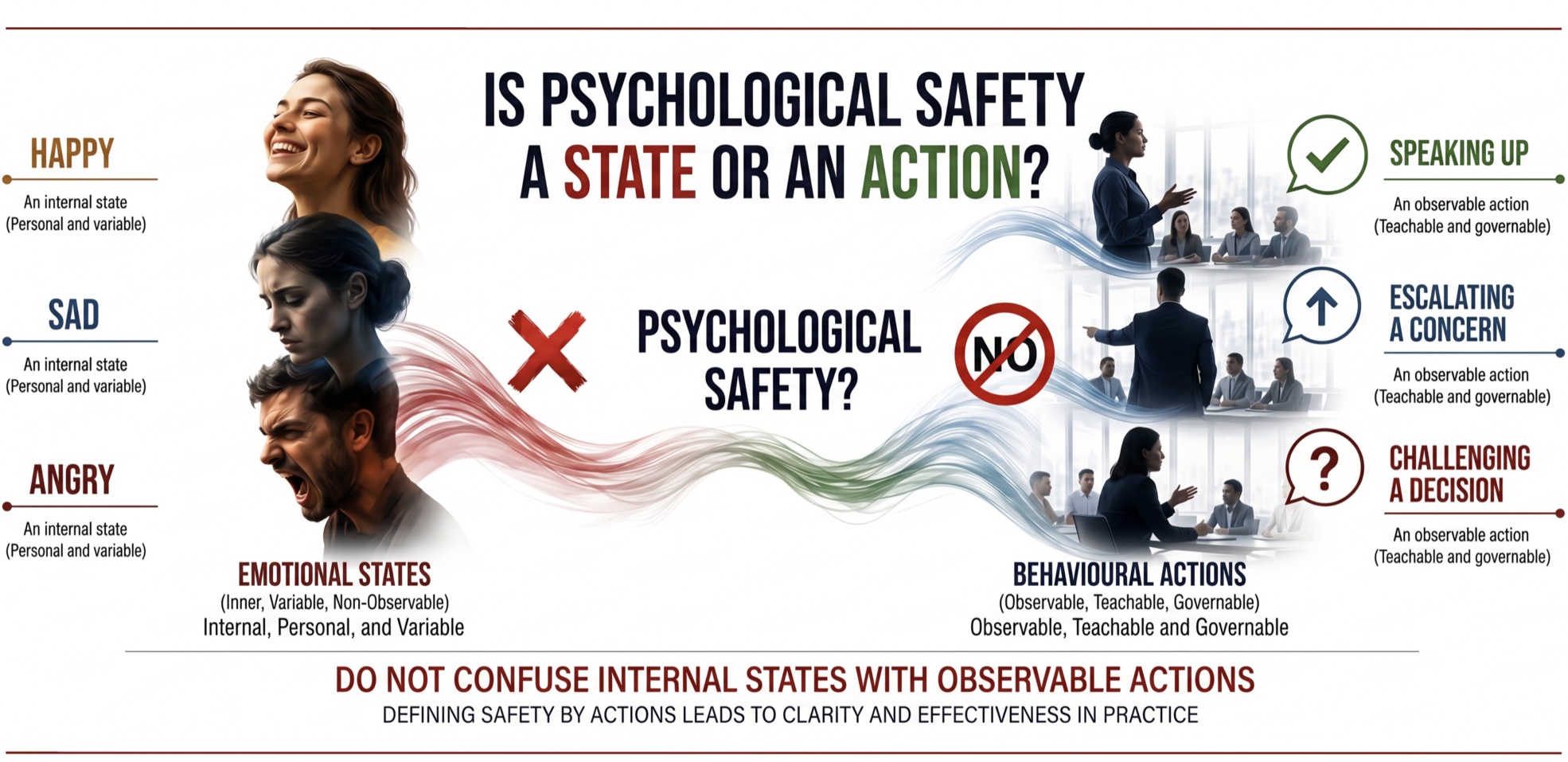
Psychological safety describes an internal psychological state, yet it is often operationalised as observable workplace behaviours such as speaking up, escalation and challenge.
The psychological safety definition most commonly cited in organisational literature is usually framed as:
“A shared belief within bounded teams that interpersonal risk-taking is tolerated.”
The concept is most closely associated with Amy Edmondson’s work on team learning and organisational behaviour.
At face value, the definition appears relatively narrow and behaviourally specific. It largely concerns whether workers feel able to raise concerns, challenge decisions, question authority, admit mistakes, or speak openly without fear of humiliation or punishment.
However, there is a deeper problem with the psychological safety definition itself.My concern is not simply that people misunderstand the concept. My concern is that the phrase “psychological safety” was always structurally prone to expansion far beyond its original bounded-team meaning.
For a wider operational and governance analysis of psychological safety, including legal accountability, organisational controls, causation and the limits of behavioural frameworks, readers can also read our main psychological safety article.
The Psychological Safety Definition and the Problem of Meaning
If the intended construct is essentially:
- Willingness to speak up
- Tolerance of challenge
- Comfort raising concerns
- Interpersonal communication confidence
- Reduced fear of embarrassment within teams
then why use the phrase “psychological safety”?
Because linguistically, the words describe something much larger than the operational definition itself.
In ordinary language, “psychological safety” naturally implies:
- Emotional protection
- Mental wellbeing
- Psychological security
- Freedom from psychological harm
- Emotional comfort
That is the ordinary meaning most people will intuitively associate with the words before reading any academic definition.
This association matters because language shapes interpretation long before technical clarification occurs.
Psychological Safety Definition or Category Error?
The psychological safety definition also contains a deeper conceptual problem.
“Psychological safety” describes a psychological condition or internal state of being.
Yet the concept is increasingly operationalised as observable behaviours such as:
- Speaking up
- Challenging decisions
- Escalating concerns
- Questioning authority
- Reporting hazards
Those are communicative acts and organisational behaviours, not psychological states themselves. This creates a category mismatch between an internal emotional condition and an external behavioural expectation.

Psychological safety describes an internal psychological condition while increasingly being used as shorthand for workplace communication behaviours.
That distinction matters operationally because organisations can influence reporting climates and escalation pathways, but they cannot fully govern the internal emotional experience of every worker.
Why the Psychological Safety Definition Was Always Likely to Expand
Once the words “psychological” and “safety” are combined, the phrase acquires enormous emotional and moral gravity.
Safety is already a morally privileged concept in modern organisations. Adding “psychological” naturally connects the phrase to ideas surrounding:
- Mental health
- Emotional wellbeing
- Vulnerability
- Trauma
- Inclusion
- Belonging
- Emotional protection
The expansion potential was built into the wording itself. This is one reason the concept spread so rapidly through:
- Leadership development
- HR systems
- Wellbeing programmes
- DEI initiatives
- Consultancy frameworks
- Psychosocial risk discussions
Modern workplace guidance increasingly reflects this expansion
The phrase itself encourages broad interpretation far beyond:
“interpersonal risk-taking within bounded work groups.”
Organisational Reality and the Limits of Psychological Safety
There is also a practical governance issue. Even organisations operating under strong employment law frameworks, whistleblowing protections, HR systems, grievance procedures, trade union representation, and Employment Tribunal oversight still routinely experience:
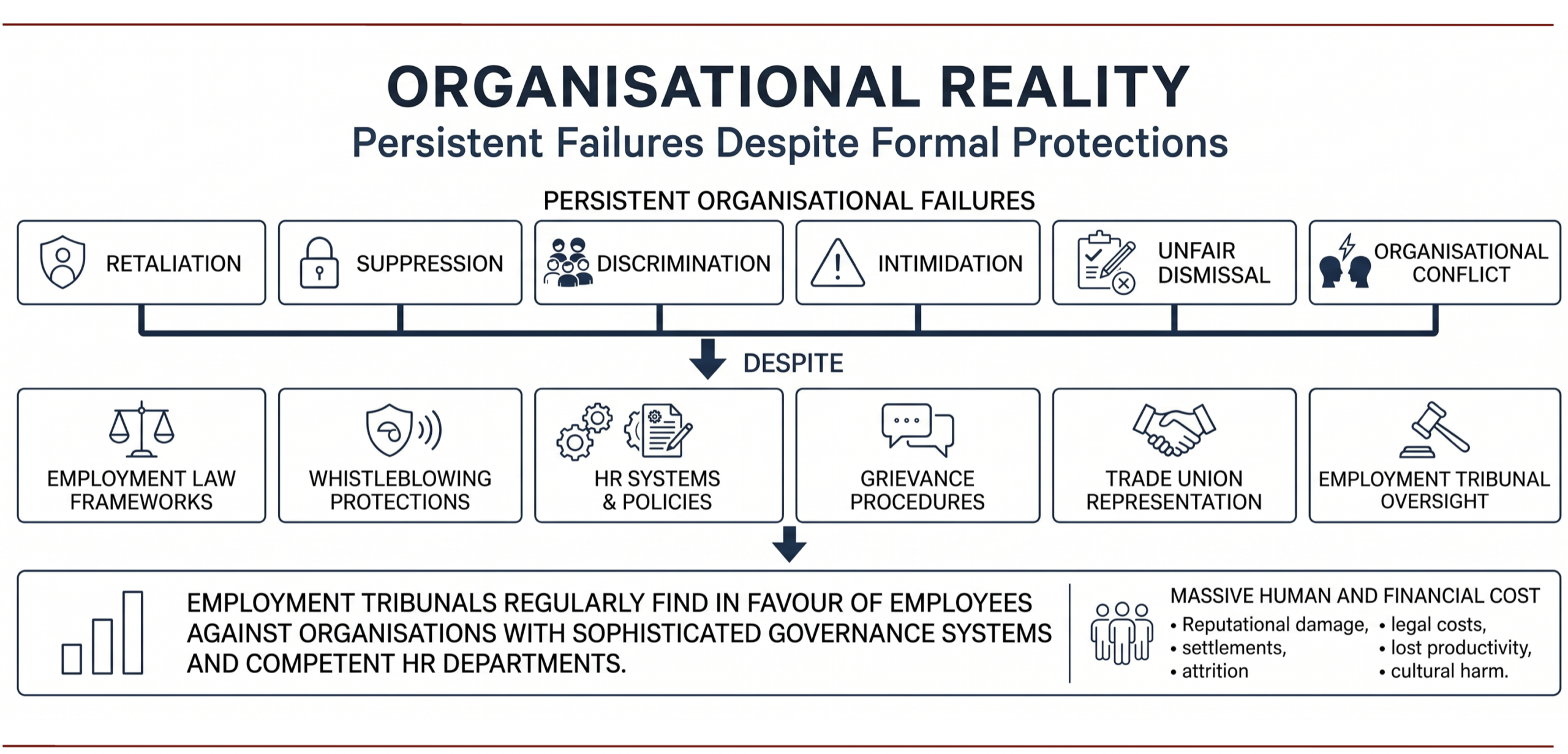
Employment Tribunals regularly find in favour of employees against organisations with sophisticated governance systems and competent HR departments. That does not mean organisations should tolerate bullying, coercion, harassment, humiliation, retaliation, or abuse. Clearly they should not. However, it does demonstrate an important limitation.
No organisation can fully guarantee the internal psychological experience of every individual because human systems remain shaped by:
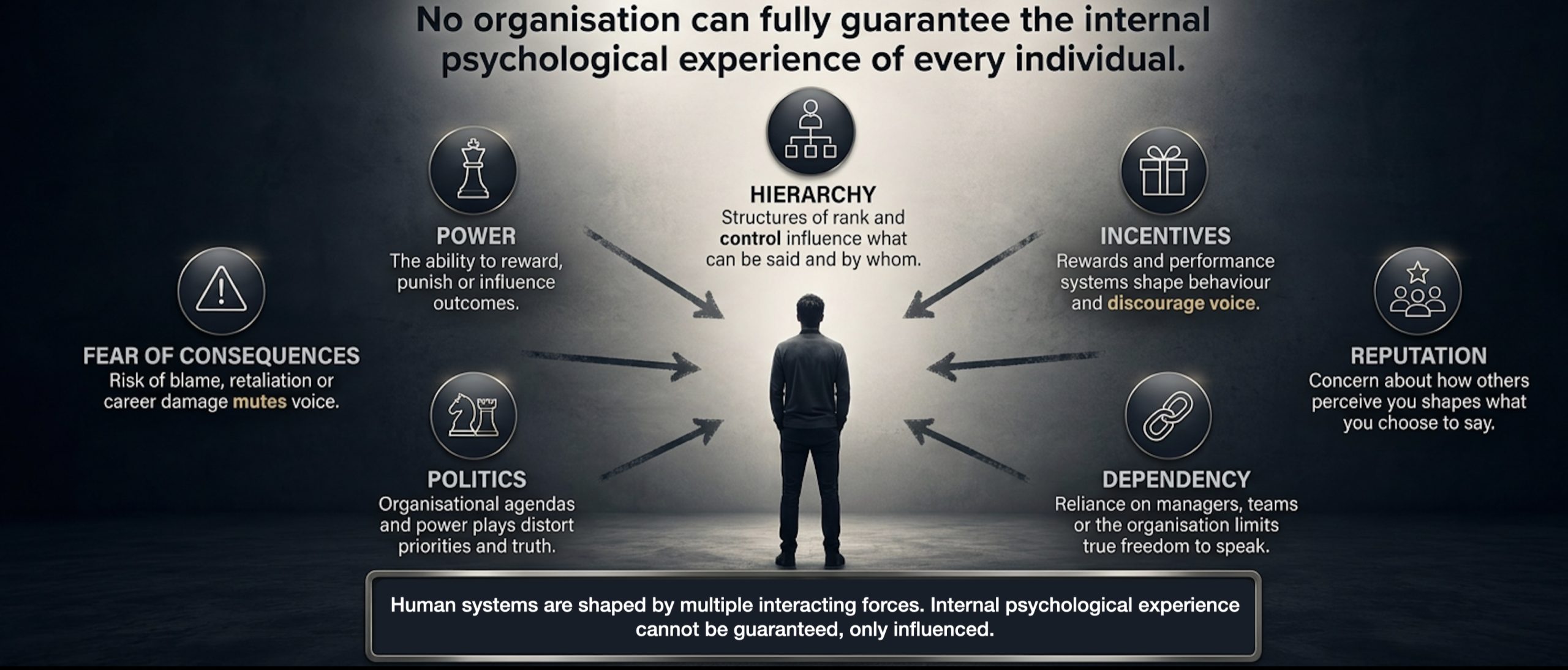
This is why the psychological safety definition becomes increasingly difficult to contain once it moves beyond its original narrow behavioural framing.
The Real Problem with the Psychological Safety Definition
The issue is not merely that people misuse the concept. The issue is that the semantic structure of the term itself predisposed it toward conceptual inflation from the outset. The wording naturally encourages expansion beyond the behavioural construct originally studied.
Amy Edmondson’s original 1999 paper on psychological safety and learning behaviour remains far narrower than many modern interpretations of the term. That expansion is now visible across modern organisational culture.
The psychological safety definition therefore contains a deeper instability: the ordinary meaning of the phrase consistently exceeds the operational boundaries of the concept itself.
Author – Phil Douglas, a Chartered Safety Professional with over 30 years’ experience managing workplace risk. Phil is a recognised expert in contractor control and permit-to-work systems, supporting organisations across the UK, USA and Europe in developing safety systems and investigating major incidents.
He heads a Gold Accredited NEBOSH Learning Centre – recognition reserved for providers consistently achieving the highest standards in safety training. Phil also contributes as a safety spokesperson on the BBC’s Jeremy Vine Show, trusted to provide competent advice to an audience of over six million people.
Continue Reading
This article has set out the linguistic and conceptual problem with psychological safety. The operational, evidential and legal case – including what the concept can and cannot demonstrate in terms of prevented harm — is set out in full in the companion piece.
Read: Safety, Inverted – The Case Against Psychological Safety →
From Critique to Control
What an Actual Safety Control Looks Like
A Permit to Work system is not a belief, an emotional state or a cultural aspiration. It is a verifiable control – legally required, operationally tested, and accountable for the work it authorises. Explore the Permit to Work Knowledge Hub: history, design, governance and practical application.

Safety, Inverted: The Case Against Psychological Safety: