Does psychological safety prevent harm? The question matters because UK workplaces have spent fifty years building statutory duties to consult, listen and act and are now being told they need an unenforceable cultural framework imported from a jurisdictions like the United States with weaker protections. That is what psychological safety criticism comes down to. Not whether respectful leadership matters. Whether a feeling can do the work of a duty
The question isn’t academic. UK occupational safety law is fifty years into its modern statutory life built across decades, often after disasters, to ensure that workers could raise concerns and that those concerns would be acted upon by people with the duty and the authority to act.
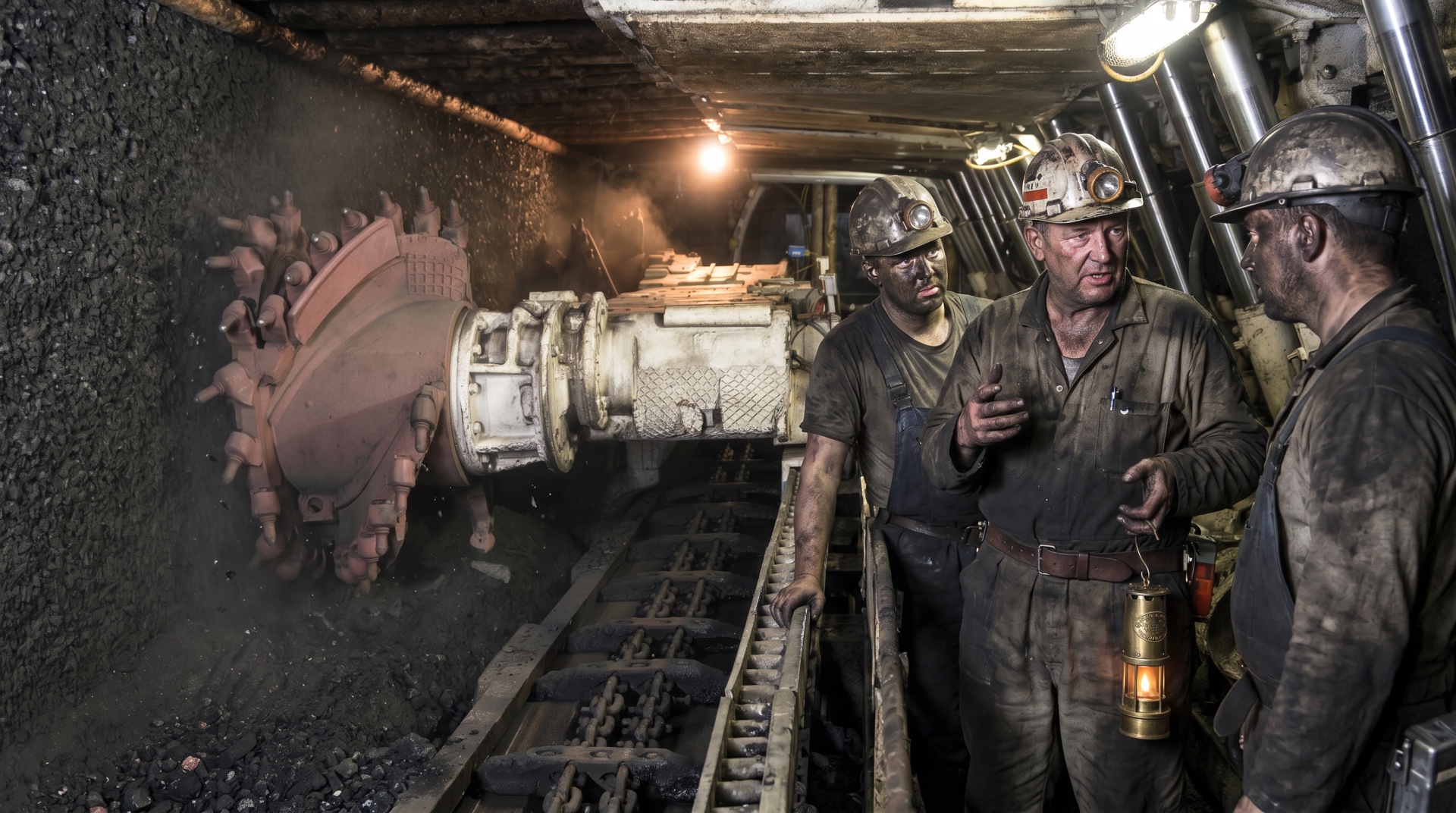
I’ve spent thirty-three years in occupational safety, starting at the coalface. I have worked under the duty, taught it to thousands of NEBOSH students, and applied it as a consultant. In all of that time, I have not seen psychological safety prevent a single incident that existing law and existing controls would not have prevented better.
This article explains why a feeling cannot do the work of a duty.
A category error in search of a problem the UK already solved
The term psychological safety has become ubiquitous in workplace discussion. It now features routinely in leadership development discussions, consultancy offerings, HR strategies, and conference keynotes. Its appeal is obvious. Create conditions in which people feel safe to speak up, and better decisions, better care, and better outcomes are expected to follow.
The concept has gained particular traction in large, risk-laden public institutions, most notably the UK NHS, where it is frequently presented as a corrective to high-profile failures, staff silencing, and cultural dysfunction. My concern is not with the aspiration. It is with the framing, the evidence, and the quiet assumption that psychological safety addresses a gap the UK has failed to solve. It does not.
In fact, the very sectors most enthusiastic about psychological safety are those where statutory duties to consult, listen, and act on risk already exist, and where repeated failures have arisen not from a lack of voice, but from ignored warnings, diffused accountability, and systemic unwillingness to act.
This article does not argue against respectful leadership, listening to workers, or understanding human behaviour. It argues against treating psychological safety as a causal control for physical harm, or as a substitute for authority, design, and enforcement.
Before examining why the modern use of psychological safety fails, it is worth being clear about where the term actually came from and what it originally meant.
Where the term ‘psychological safety’ came from
The phrase psychological safety was coined in 1954 by Carl Rogers, the humanistic psychologist and psychotherapist. Rogers used it in a paper on creativity, not workplace culture. For Rogers, psychological safety was associated with three specific processes: accepting the individual as of unconditional worth, providing a climate in which external evaluation is absent, and understanding empathically. It was a bounded concept about individual creativity within therapeutic relationships. Rogers wrote that by setting up conditions of psychological safety and freedom, we maximise the likelihood of an emergence of constructive creativity. The context was clinical. The subject was the individual. The application was therapy.
In 1965, Edgar Schein and Warren Bennis shifted the term into organisational change, defining it as an atmosphere where one can take chances without fear and with sufficient protection, a climate which tolerates failure without retaliation. The focus moved from individual creativity to group dynamics.
In 1990, William Kahn shifted it again, describing psychological safety as the sense of being able to show and employ one’s self without fear of negative consequences to self-image, status, or career. The focus moved to employee engagement.
In 1999, Amy Edmondson reframed the concept as a team-level shared belief and developed a measurement scale to explain why some teams reported more errors than others. Her original empirical work was descriptive, explaining variance in reporting behaviour in hospital nursing teams. It is worth being precise about what she did and did not claim. Edmondson’s narrow finding that teams reporting higher psychological safety also reported more errors, which she interpreted as better learning survives careful examination. The expanded framework that has grown around it, in which psychological safety is marketed as a foundation of innovation, performance, and harm prevention, is a different proposition entirely. The critique that follows is aimed at the expanded framework as it is sold and applied, not at Edmondson’s original empirical observation.
By the time of The Fearless Organization in 2018, a bounded therapeutic concept had become a marketed organisational lever, with training programmes, consultancy offerings, and conference keynotes attached. What happened across those decades was conceptual inflation. A term with a precise clinical meaning was lifted out of context, had its boundaries stripped away, and was progressively repurposed until it stood in for the very structural protections that would actually make the observed condition possible. This is not academic plagiarism, but it is becoming common. The borrowed credibility of the original term obscures the fact that the modern usage has departed entirely from what the term originally meant.
The category error
The term psychological safety commits a category error by conflating two fundamentally different concepts:
Safety – In an occupational sense, refers to the absence or control of conditions likely to cause harm. Safety is a legal and engineering concept. It involves duties, controls, and accountability. It can be assessed through outcomes such as injuries, ill health, and fatalities. It is enforceable.
Psychology – refers to a subjective emotional state. It is a feeling that one can speak up without fear of ridicule, embarrassment, or interpersonal consequence. It is cultural and interpersonal. It cannot be enforced. It has no statutory footing. And crucially, it is not safety. It is atmosphere.
A feeling may support safety, but it cannot substitute for it.
By attaching the word safety to a subjective experience, we borrow the moral weight of a term associated with protection from harm and apply it to team dynamics. That matters. It allows organisations to claim progress on “safety” while working almost exclusively on culture, and it blurs the distinction between feeling safe and being safe.
You can have strong psychological safety and poor physical safety. A team may speak openly while guarding is missing and permits are unsigned. Equally, you can have weak psychological safety and strong physical safety. A blunt, uncomfortable workplace where controls are robust and people are not harmed.
The difference matters when outcomes matter. Understanding that history makes the central problem easier to see, because the modern usage quietly reverses the relationship between cause and effect.

The cause – effect inversion at the heart of psychological safety
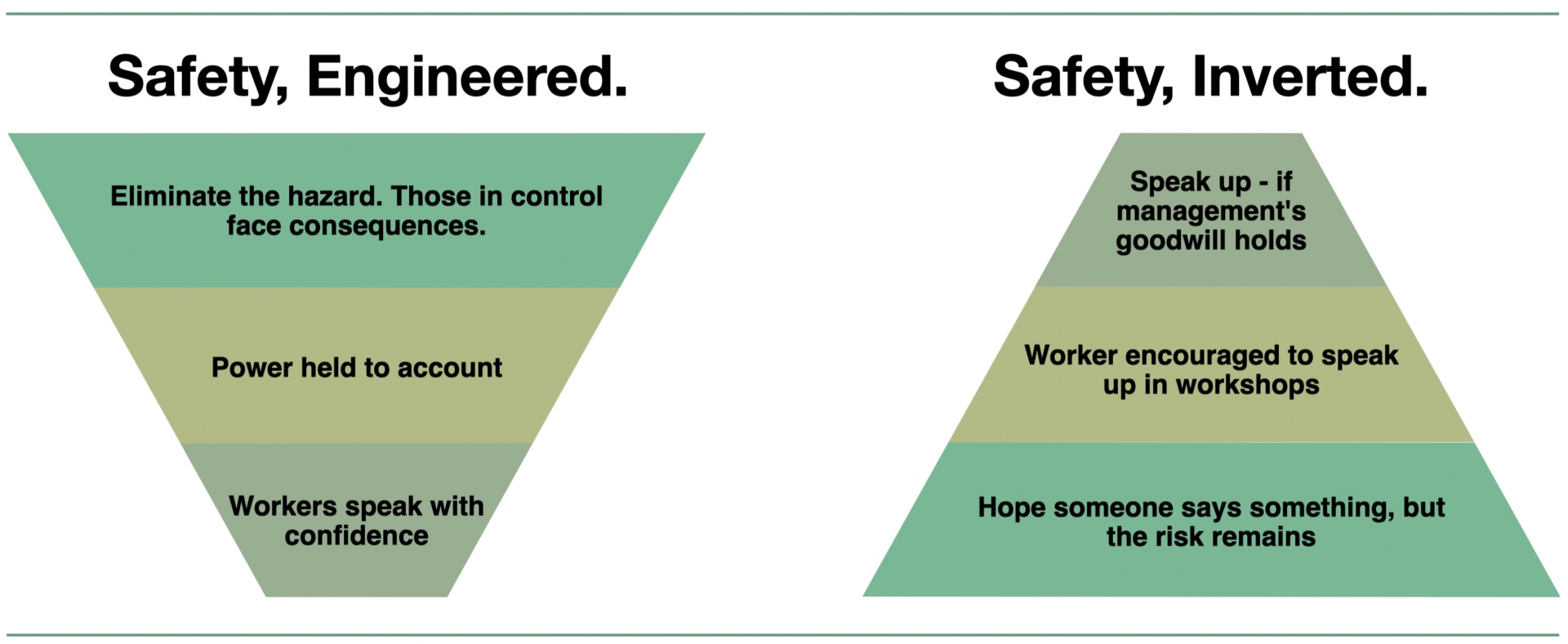
The modern psychological safety narrative repeatedly commits a basic cause and effect inversion. It treats candid speech as the mechanism that creates safety, rather than as evidence that safety already exists. People speak up when it is safe to do so in reality. That safety is created by authority limits, credible protections, aligned incentives, and consequences for retaliation.
Where those conditions are absent, fear is not a cultural defect. It is a rational reading of risk based on power and past outcomes. This is why the term becomes slippery in debate. When challenged on mechanism, advocates often redefine psychological safety to include the very controls that are doing the work. But if the controls operate independently of the label, then the label is not causal. It is an after the fact description of a workplace where governance is already functioning. A description can be useful. It cannot be sold as the control.
You can connect psychology to almost anything. That does not mean it caused everything. And it certainly does not excuse anything.
Phil Douglas
A causality test for safety ideas
That inversion can be tested. Judea Pearl, Turing Award winner and one of the world’s leading thinkers on causal reasoning, sets a demanding test for any idea that claims to improve outcomes through intervention.
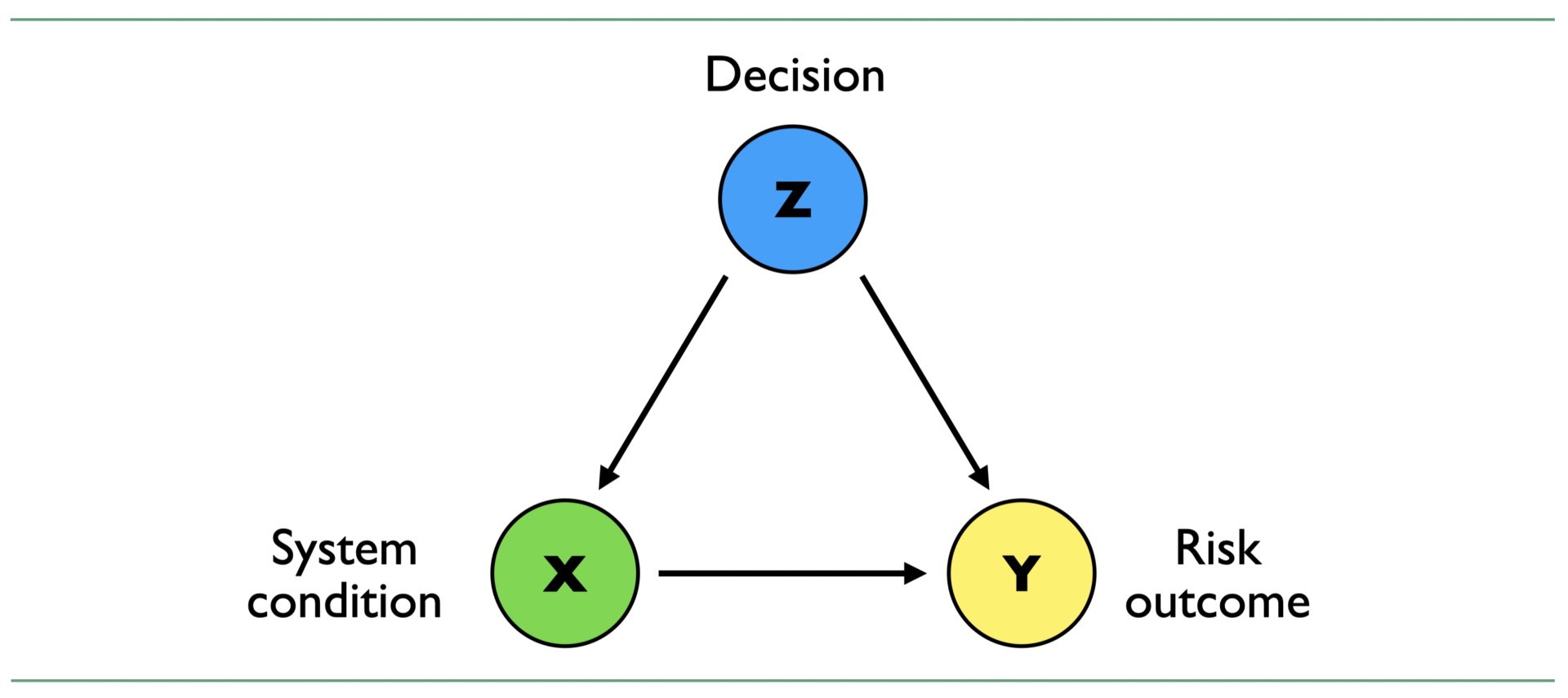
A simple way to test whether a safety idea is causally coherent is to ask three questions:
- What decision is made?
- What changes in the system as a result?
- What happens to the risk because of that change?
The diagram below shows this structure:
Example:
- Decision: Management choose to install a barrier
- System condition: Physical separation between FLT and pedestrians
- Risk outcome: Risk of a pedestrian being struck
Now apply the same three questions to psychological safety.
- Decision: Leaders encourage openness and respectful speaking up
- System condition: Psychological safety
- Risk outcome: Fewer injuries
What exactly changed in the system?
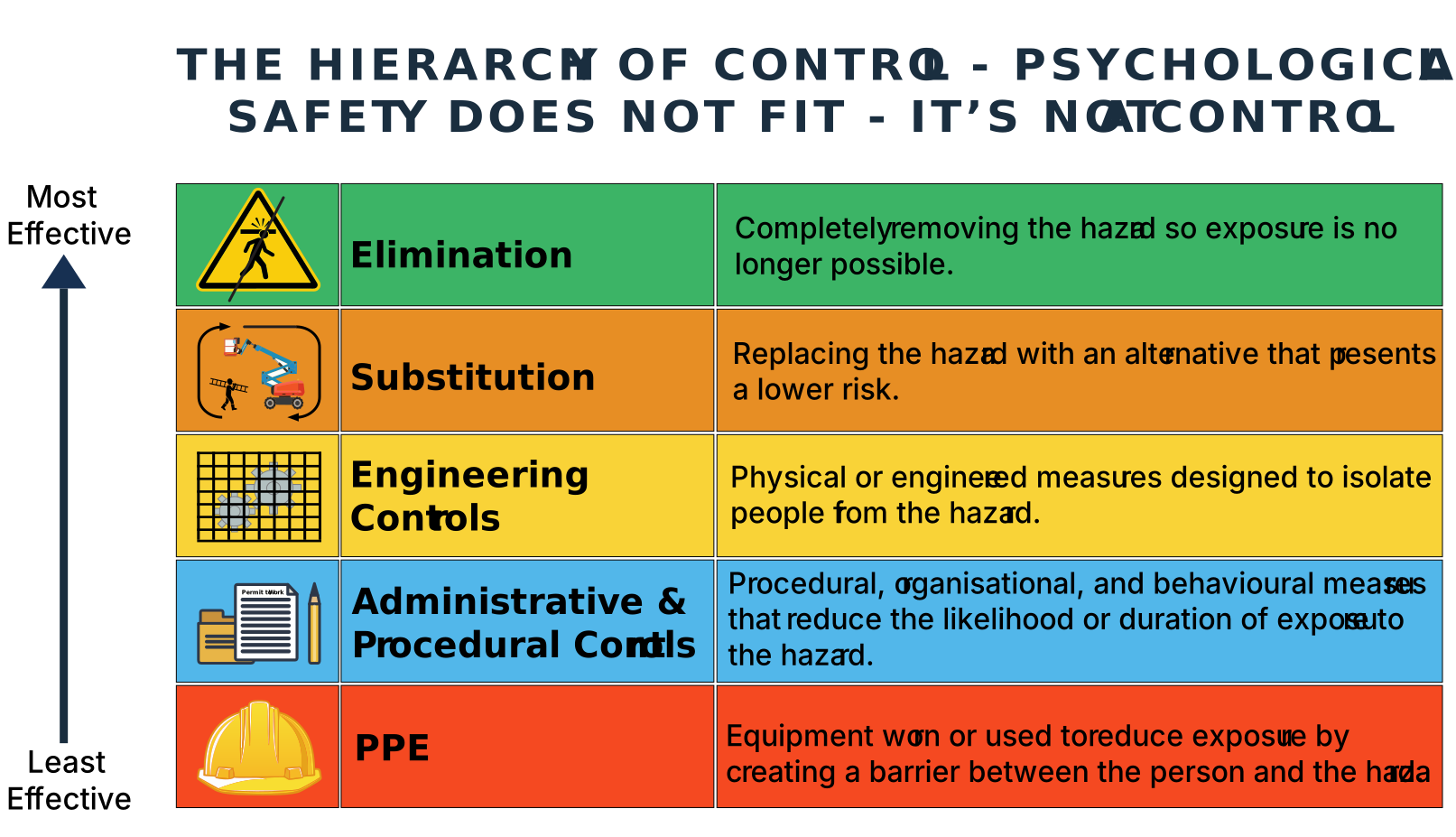
This is the difference between describing a problem and being able to change it. Safety engineering lives in that third world. Barriers, guards, segregation, ventilation, supervision, training, and enforcement all pass this test. You can change them. You can predict the effect. You can defend the decision.
Pearl’s framework, explained for a general audience in The Book of Why, is now widely used across AI, epidemiology, economics, and social science to separate causal claims from narrative claims. Psychological safety, run through this test, has nothing to put in the second column. The intervention does not specify a manipulable variable. The system condition is a self-reported feeling. The link to the risk outcome is asserted rather than shown.
When language displaces control
One of the risks in elevating psychological safety to a primary safety intervention is that it displaces attention from the things that actually prevent harm. Once safety is framed primarily as a feeling, the focus shifts. Structural issues become interpersonal ones. Decisions about workload, staffing, time pressure, and resources fade into the background, replaced by conversations about tone, openness, and trust.
Real harm is rarely caused by a lack of emotional comfort. It is caused by very ordinary failures. These are the same failures consistently cited in enforcement action following serious incidents by regulators such as the UK Health and Safety Executive, Safe Work Australia, and labour inspectorates across the EU and Canada, where investigations focus on foreseeability, control, and failure to act.
- Unguarded machinery
- Inadequate isolation
- Poorly designed work processes
- Uncontrolled change
- Normalised deviation
- Decisions taken without understanding their consequences
None of these hazards are resolved by people feeling more able to speak. They are resolved by design, engineering, supervision, and control.
The structural inversion in summary
The structural inversion is now visible. Two foundations. One holds.
An academic warning from inside the tent
This critique is not mine alone. It is being made independently from several directions, by researchers and practitioners with no shared agenda beyond methodological seriousness.
Dominic Cooper has more than 25 years’ hands-on experience in occupational safety and psychology, and previously held a professorship in safety and industrial and organisational psychology. Across his published work, he consistently shows that situational and behavioural factors such as work design, supervision, and systems of control demonstrate stronger and more reliable relationships with safety outcomes than broad psychological constructs. He has been sharply critical of ideological approaches that lack peer-reviewed evidence of injury reduction, arguing that the global OSH profession must refocus on interventions that demonstrably reduce exposure to harm, rather than untested frameworks marketed as universal solutions.
Rob Briner, Professor of Organisational Psychology at Queen Mary University of London and Scientific Director of the Centre for Evidence-Based Management, has built a career questioning management and HR concepts that spread without adequate evidence. Named Most Influential HR Thinker by HR Magazine, Briner persistently asks the question practitioners often avoid: does this actually work? His critique of employee engagement that the evidence for its impact on performance is weak applies with equal force to psychological safety. As he has observed: “Everybody always uses evidence, but that’s not the same as evidence-based practice.”
Peter Cappelli, Professor at Wharton Business School, has published research directly challenging the assumption that psychological safety should always be maximised. His 2024 paper, The Limits of Psychological Safety, found that pushing psychological safety to very high levels can undermine performance in routine or rule-bound work, where clarity, standards, and accountability are critical. As Cappelli noted, psychological safety was intended to support learning and creativity, not to imply the absence of consequences for poor performance or failure to follow rules.
Anthony Montgomery at Northumbria University continues to warn that his own discipline is packaging tentative research concepts as finished solutions. He describes the result as an illusion of psychological safety, where organisations become comfortable hearing what they were already prepared to hear, while the structural causes of harm remain untouched.
Nektarios Karanikas, Associate Professor at Queensland University of Technology, has reinforced this position from within OHS scholarship. His 2024 paper in Safety Science, co-authored with Haroun Zerguine, defines safety as “actions to control risks” actions, not feelings or climates. The authors distinguish sharply between actions, which directly control risk, and interventions, which provide resources for others to act. By their analysis, workshops on psychological safety are interventions of a particularly thin kind: they provide language rather than resources, producing climate rather than action
Even Amy Edmondson, who originated the concept, has repeatedly stressed that psychological safety is not the absence of accountability, does not mean lowering standards, and was never intended to create a ‘comfort zone’ in which poor performance or rule breaking carry no consequence.
Five different perspectives. One consistent message: the current evidence does not support the expansive claims being made for psychological safety as a primary safety intervention. We should be deeply sceptical of any framework that promises cultural transformation without demonstrable harm prevention.
Social media, LinkedIn consultants and the growth of the psychological safety industry

Many of the strongest claims about psychological safety do not come from peer reviewed evidence or long term field data. They come from consultants, LinkedIn influencers and commercial providers whose income depends on organisations believing there is a problem that only they can solve.
This is one reason why psychological safety criticism is often met with hostility. Challenging the concept does not simply challenge an idea. It challenges a business model.
On social media, particularly LinkedIn, psychological safety is frequently presented as the answer to almost every organisational problem: poor communication, low trust, weak leadership, bullying, stress, lack of innovation and even major safety failures.
The difficulty is that these claims often go well beyond the available psychological safety evidence. There is very little hard evidence showing that psychological safety interventions, workshops or surveys prevent harm in the way that stronger controls do. By contrast, there is extensive evidence for legal protection, trade union representation, competent supervision, proper enforcement and real consequences for retaliation.
This is where the debate becomes one of psychological safety vs accountability.
If a worker is afraid to speak up because previous concerns have been ignored or punished, the primary problem is not their confidence, breathing, mindset or communication style. The problem is that the organisation has failed to make it genuinely safe to speak.
Too often, social media consultants focus on helping workers adapt to a poor system rather than demanding that the poor system be changed.
There is also a sharper distinction worth naming. There is a difference between being wrong and continuing anyway. In any developing field, people will hold flawed views sincerely. That is normal. Those arguments can be tested, challenged, and sometimes changed. The more serious problem is persistence. The empirical weakness of psychological safety as a primary safety intervention is quietly acknowledged often in passing, often in the small print of the same articles that promote it, but the framework continues to be marketed as if that weakness does not exist. At that point, the issue is no longer error. It is persistence. Whether that persistence is driven by belief, identity, or commercial incentive makes little difference to the outcome. Dutyholders still make decisions on the back of it. Organisations still restructure around it. And the field moves further away from interventions that pass the prevented-incident test.
That is why the key question remains:
Does psychological safety prevent harm, or does it sometimes distract attention from the more difficult but more effective solutions?
Phil Douglas
What the UK already has
What is striking in the UK context is how often psychological safety is discussed as if the problem of speaking up hasn’t already been addressed.
It has. In statute.
Under the Health and Safety at Work etc. Act 1974 — employers have a duty under section 2(1) to ensure, so far as is reasonably practicable, the health, safety, and welfare of their employees. That duty includes making arrangements for safe systems of work, information, instruction, training, and supervision under section 2(2), and a specific duty under section 2(6) to consult employees or their representatives on the arrangements made to secure health and safety at work.
The Management of Health and Safety at Work Regulations 1999 reinforce the duties set out in the Health and Safety at Work etc. Act 1974. Under regulation 14, employees have a legal duty to report serious and immediate dangers and any shortcomings in protective arrangements. Under regulation 5, employers must have effective arrangements for the planning, organisation, control, monitoring, and review of preventive and protective measures.
The duty to consult and respond is not optional. It is reinforced through statutory consultation requirements.
The Safety Representatives and Safety Committees Regulations 1977 give recognised trade union safety representatives defined rights, standing, and protections, including rights to investigate hazards and be consulted on health and safety matters. Where those regulations do not apply, the Health and Safety (Consultation with Employees) Regulations 1996 impose equivalent duties to consult employees directly.
The Employment Rights Act 1996 completes the picture. It provides explicit protection for workers who raise health and safety concerns, including protection from detriment or dismissal for doing so. In law, retaliation for speaking up is already prohibited. The problem is not the absence of protection. It is how that protection is mediated.
The UK didn’t get safer by accident. Fatal injuries have fallen from over 600 a year in the early 1970s to around 138 today, a reduction of close to 80%. That progress was delivered through law, enforcement and control, long before “psychological safety” became a workplace buzzword.
In practice, this legislation is filtered through HR functions and employment lawyers who act as gatekeepers rather than guarantors. The law is routinely abstracted into policy language, procedural checklists, and risk-managed advice designed to protect organisations from liability rather than workers from harm. These actors rarely deal with the downstream consequences of organisational failure. They are not present at the inquest, the prosecution, or the site of the incident. Nor do they design or implement the controls that would have prevented it. Their commercial incentive is to manage exposure, not eliminate risk. Genuine solutions that challenge power, resourcing, or operational pressure are inconvenient to the organisations that pay their fees, and so they are quietly avoided.
That’s why appeals to psychological safety are so hollow in this context. If legal protection backed by statute, case law, and sanction is diluted in practice, a goodwill-based framework has no chance. The issue is not courage, culture, or confidence. It is enforcement, power, and consequence.
In practice, compliance at senior leadership level means consulting workers and their representatives, acting on reported risks, implementing controls, reviewing effectiveness, and intervening when exposure is known. It does not depend on goodwill or managerial benevolence. It rests on legal responsibility, representation, and accountability.
What tends to be glossed over by wellness consultants and academics selling psychological safety to industry is the existence of the legal framework set out above. UK law already compels speaking up, consultation, and action. When organisations fail to listen or act, that’s not evidence of a missing concept. It is evidence of failed leadership, weak governance, or ignored duties.
Rebranding that failure as a cultural or psychological deficit is convenient. It shifts attention away from accountability and towards atmosphere. It also sidesteps an awkward truth. If statutory duties, backed by enforcement powers and sanctions, are not being applied effectively, then a framework like psychological safety, which is unenforceable and dependent on managerial goodwill, is doomed from the outset. It has less leverage, not more.
That is not progress. It’s a step backwards.
Law versus aspiration
This is the point where the discussion has to move from aspiration to obligation. Law does not ask whether a workplace climate feels supportive. It asks who had duty, who had authority, what was foreseeable, what steps were reasonably practicable, and what happened when warnings were raised. Law exists precisely because power and incentives cannot be trusted to self regulate. It provides enforceable duties, minimum standards, and consequences. Psychological safety, as commonly sold, offers none of that. It has no enforceable definition, no completion state, and no independent protective mechanism.
At best it is an aspiration, a leadership intention, or a description of how people report they feel. Those things may be pleasant. They are not safeguards. When a concept invites leaders to talk about mindsets and climates instead of making clear decisions, enforcing standards, protecting reporters, and disciplining retaliation, it becomes a substitute for moral judgement and legal seriousness. That is the risk. It looks progressive while leaving the underlying power dynamics untouched.
Where psychological safety takes hold
Psychological safety as a workplace concept is not evenly distributed across sectors. It appears most prominently in large, complex, reputation-sensitive organisations where failure is already visible and where formal mechanisms for worker voice already exist.
It has gained particular traction in the UK NHS, local government, higher education, and other public bodies, and in large corporate organisations following scandal, inquiry, or regulatory criticism. These are not environments lacking reporting channels, consultation duties, or opportunities to raise concern. On the contrary, they are often saturated with them. What they share is not silence, but difficulty acting on what is already known. Warnings are raised, data exists, and concerns are logged, yet decisions are delayed, responsibility diffused, or action constrained by political, financial, or organisational pressures.
Grenfell makes this clear with uncomfortable specificity. Concerns about fire safety, cladding, and the treatment of resident complaints were raised repeatedly in the years before the fire through tenant organisations, through formal correspondence with the landlord, through every channel that a speak-up culture would claim to need. They were not absent. They were not unheard. They were discounted, delayed, and in some cases dismissed. The Grenfell Tower Inquiry findings describe a sustained pattern in which those responsible for building safety failed to act on known risks, while residents raising concerns were treated as troublesome or ignored. The failure was not one of voice. It was a failure of responsibility, decision, and consequence at the point where action was required.
Where systems already have voice but struggle to act, psychological safety becomes attractive, not because it adds anything operational, but because it reframes systemic failure as a cultural communication issue. It focuses attention on how people feel about speaking up, rather than on who has the authority to act, what decisions were taken, or why known risks were tolerated. It offers a language of care and openness at a point where structural change is harder, slower, and more contested.
The pattern is diagnostic. Psychological safety flourishes most where systems are struggling to respond, not where they lack information. That distinction matters because it explains why so many well-intentioned efforts focus on encouraging voice while leaving the underlying conditions unchanged.

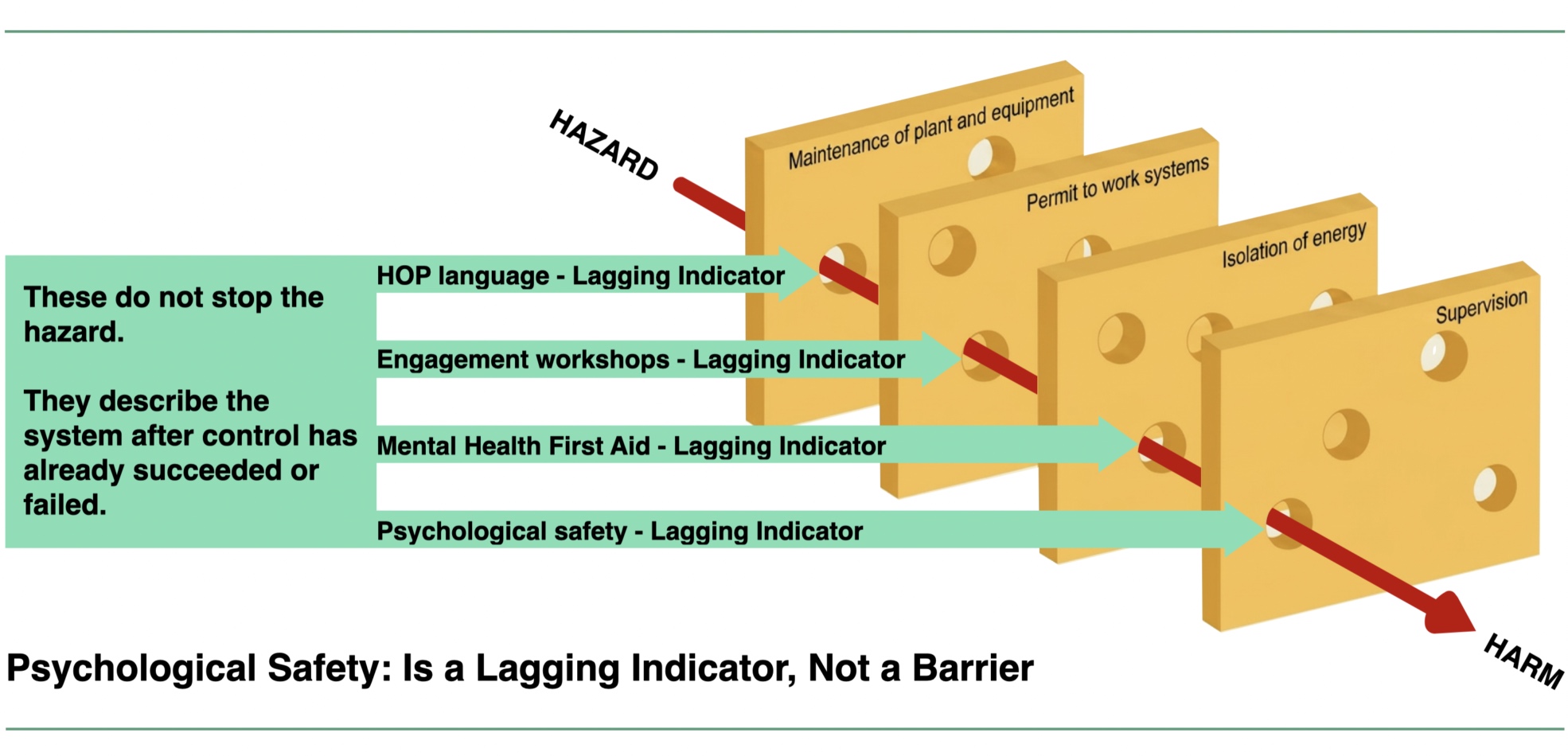
Candid speech is a lagging indicator, not a control
Candid speech is a lagging indicator. It appears after protection is credible, not before. When employees raise concerns freely, it usually signals that the organisation has already demonstrated, over time, that speaking up does not lead to punishment and that action follows escalation. The reverse is equally true. Silence often follows ignored escalation, not lack of caring, not lack of courage, and not lack of training. If people have watched others suffer for speaking up, they learn. If raising concerns changes nothing, they stop investing effort and risk. That is not a psychological mystery. It is normal human risk management.
The practical implication is straightforward. If leaders want clean information, they need to make retaliation professionally expensive, make protection real, align incentives, and prove through action that escalation changes outcomes. You do not workshop your way to that. You enforce your way to it.
When coping is mistaken for control
A recurring failure in psychological safety discourse is the importation of therapeutic language into organisational risk management. Coping, resilience, and recovery are retrospective responses to harm that has already occurred. They are not preventive controls.
A January 2026 lawsuit against CBC North illustrates the point. A former HR specialist has alleged a workplace so routinely distressing that employees used an unofficial crying room to manage their distress. The existence of such a space is not evidence of psychological safety. It is evidence of its absence. When workers withdraw to cope in private, the system has already failed.
When employees improvise coping spaces or develop personal resilience strategies in order to endure harmful conditions, this is not evidence of protection. It is a lagging indicator that exposure has already become unacceptable. Reframing such behaviours as resilience building or risk mitigation inverts cause and effect, signal and solution, duty and coping.
In safety and employment law, responsibility is not evenly distributed. Employers design work, set demands, and hold the primary duty to prevent foreseeable harm. Courts, regulators, and enforcement bodies do not treat survival, adaptation, or emotional endurance as evidence of control. They look for design decisions, authority, workload management, supervision, and enforcement.
When resilience narratives are used to reframe coping as success, they do not improve safety. They mask structural failure and quietly relocate responsibility from systems to individuals.
That a therapist could publicly endorse workplace crying rooms as a resilience-building intervention, rather than recognising them as a symptom of failed duty, shows how far therapeutic language has drifted from the realities of organisational accountability.
The vacuum psychological safety filled
Psychological safety did not arrive into a vacuum that needed filling. It arrived into a space where collective worker power had been eroded first in the United States, where it never fully existed, and then in the United Kingdom, where it was deliberately weakened.
In the United States, employment protection is weak. Union density is low. Regulatory enforcement is limited. Healthcare is often tied to employment. In that environment, speaking up can carry real personal risk. Psychological safety functions as a workaround. Where there is no legal voice, cultural permission fills the gap.
The UK did not have that gap. In 1980, UK trade union density stood at around fifty percent. In the private sector today, it is closer to twelve percent. What replaced it was not stronger individual rights or more robust enforcement. It was HR, wellness programmes, and therapeutic frameworks that offer dialogue without leverage.
Trade unions provided collective power, legal standing, and the capacity to compel change. A union representative could escalate, negotiate, and if necessary, organise action that carried real cost for the employer. Psychological safety offers conversation, climate surveys, and the promise of being heard. One could shut down a dangerous process. The other can only hope management listens.
This substitution has consequences. When collective voice existed, intolerable conditions met organised resistance. Today, the same conditions are met with coping strategies, resilience training, and rooms set aside for private distress. The burden has shifted from the employer who designs the work to the employee who must endure it.
The crying room exists because people have forgotten they can fight back. Or have been told it is not psychologically safe to do so.

Psychological safety did not emerge to replace trade unions. But it now occupies the space they left behind, offering a language of care without any of the power that once made care enforceable. That is not progress. It is managed decline dressed as cultural improvement.
Importing American cultural models into a jurisdiction with established statutory protections risks creating duplication at best, and confusion at worst. It replaces enforceable duties with managerial preferences and reframes rights as feelings.
A pattern beyond safety: the substrate problem
This pattern of borrowed credibility isn’t unique to safety. It runs across modern management consulting.
Consider the word substrate. In chemistry and biology, substrate has a precise, established meaning. In biochemistry, an enzyme substrate is the molecule upon which an enzyme acts. In biology, a substrate is the surface on which an organism lives. The term refers to something concrete, reachable, and verifiable.
In practical terms, getting down to the substrate is routine work. When preparing a wall for repainting, for example, reaching the substrate means removing old paint with an orbital sander and progressively finer grades of abrasive mesh, applying undercoats with sanding between, and finishing with topcoats to achieve proper adhesion and sheen. The substrate is the underlying surface. You can get to it. The outcome is measurable. The process is repeatable. Failure has visible consequences.
Now compare this to the use of substrate in contemporary complexity theory, where substrate management is described as the process of designing and evolving the substrate’s properties to make various information-theoretic tasks intrinsically easy, robust, and natural. What is the substrate in this usage? How do you know when you have reached it? What does success look like? What does failure look like? The answers are undefined, unmeasurable, and conveniently unclear.
The pattern is the same. Take a term with established, bounded meaning in another discipline, import it into management consulting, strip away the precision, and sell it as something new. When challenged, the defence is predictable: you do not understand the concept. But the evidence shows the opposite. It is the importers who have departed from the original concept while borrowing its credibility.
Psychological safety is the same move applied to occupational safety. Substrate-style appropriation is the genre. The article you are reading is, in part, an objection to the genre.
The real question
The real question is not how we make people feel safe to speak. It’s who they are expected to speak to, and whether that person has both the authority and the legal obligation to act when risk is raised.
Psychological safety initiatives that ignore who controls resources, sets priorities, and accepts exposure do not address causes. They manage sentiment morale may improve. Risk may remain unchanged.
A failure of psychological safety may be uncomfortable. A failure of consultation and response is unlawful.
Where I stand
Psychological safety is not a bad aspiration. A workplace where people feel able to raise concerns without fear is, all else being equal, preferable to one where they do not.
But it is not safety, and it is not a substitute for it.
Psychological safety may influence speaking inside a bounded, low-risk team – where members know each other, routines are stable, and escalation routes already exist. Outside those conditions, its effect is asserted rather than shown.
It does not ensure:
- Action
- Control
- Protection
It does not hold when a worker is:
- Alone
- Exposed
- Up against power they cannot challenge
The frame collapses precisely where it would be needed most.
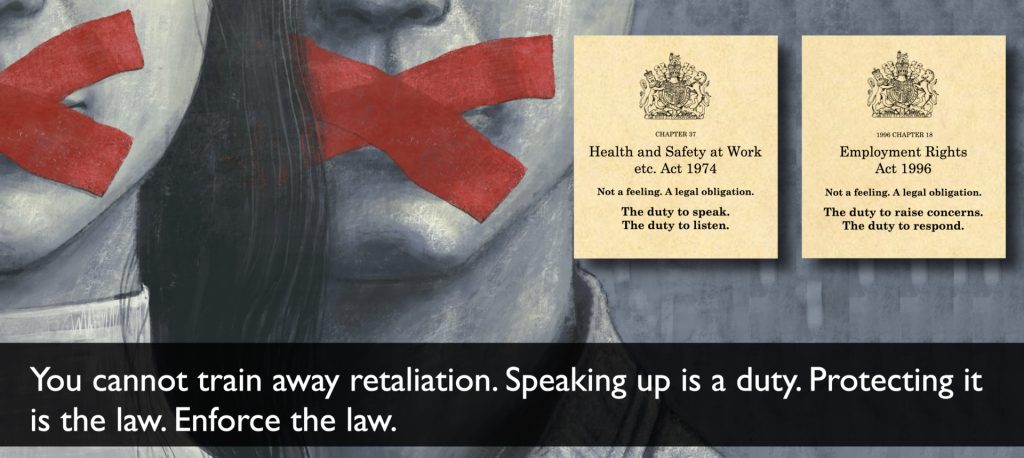
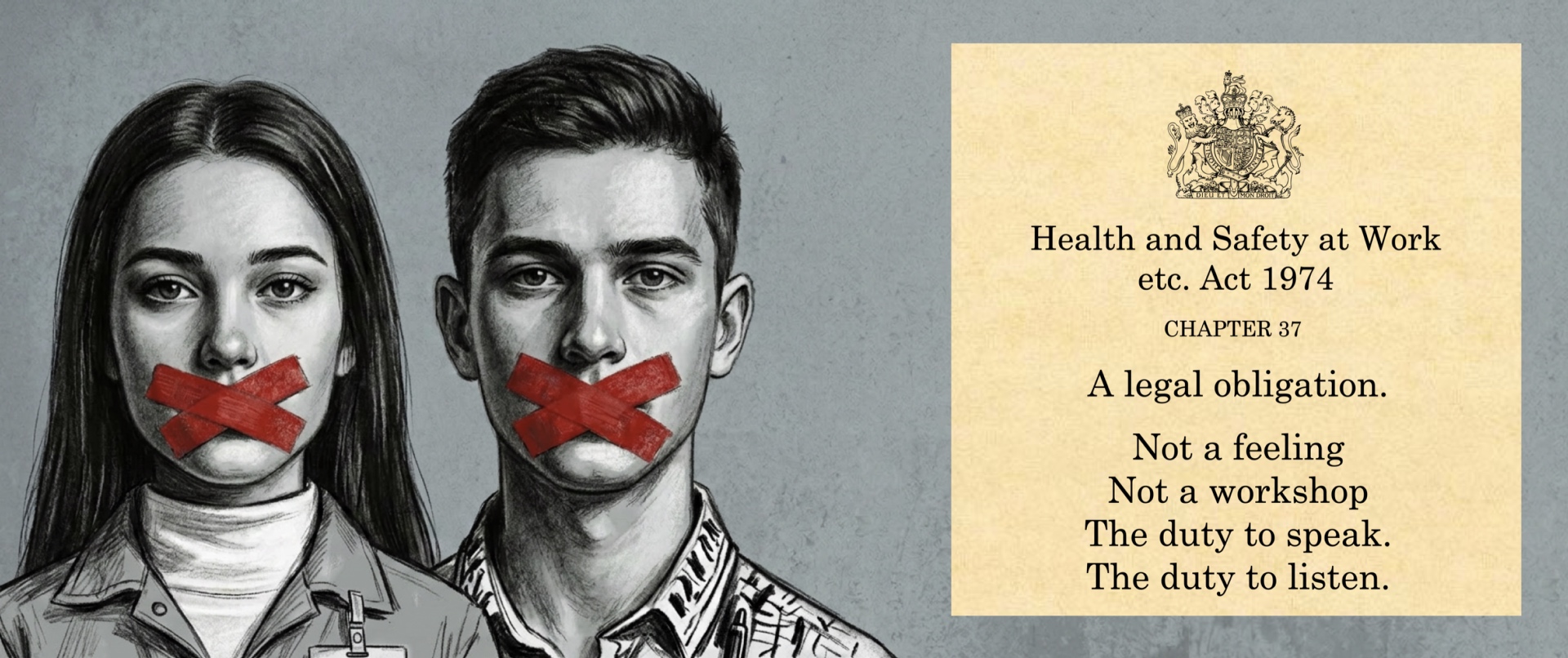
In the UK, we don’t need to import cultural models from jurisdictions with weaker worker protections. We need to use the legal framework we already have and enforce the duties Parliament imposed decades ago.
The duty to speak.
The duty to listen.
Not a feeling. A legal obligation.
Workers don’t need permission to speak. They need power, protection, and consequence when they do.
Frequently asked questions
Is psychological safety supported by evidence?
There is evidence that fear correlates with under reporting and reduced information flow. That is not in dispute. What is missing is evidence that psychological safety, as a concept, functions as a preventative control. The research largely describes conditions under which people speak up. It does not demonstrate that the concept itself removes retaliation, constrains authority, overrides incentives, or prevents harm before decisions are taken.
Does psychological safety prevent retaliation?
No. Retaliation is prevented by enforceable rules, clear authority limits, disciplinary consequences, contractual protection, and legal remedy. Psychological safety has no independent mechanism to prevent retaliation. At best, it describes how people feel in environments where retaliation is already unlikely.
Is psychological safety a legal requirement in the UK?
No. UK health and safety law does not recognise psychological safety as a duty or standard. Legal duties are defined through statute, regulation, and case law. Employers are required to consult, assess risk, manage hazards, and protect employees from detriment for raising concerns. These duties exist regardless of culture or leadership style.
How does psychological safety differ from legal duty?
Legal duties are enforceable, specific, and backed by sanction. Psychological safety is aspirational, undefined, and unenforceable. Law governs what must be done and what happens when it is not. Psychological safety offers no equivalent mechanism for accountability.
Does encouraging people to speak up improve safety?
Encouraging voice can improve information flow, but only where protection already exists. Speaking up is a lagging indicator of safety, not a control. People speak freely when past experience shows that raising concerns leads to action and does not result in harm to the individual.
What actually protects people who raise concerns?
Protection comes from governance, not climate. Clear decision rights, documented escalation routes, independent investigation, disciplinary action for suppression or retaliation, contractual safeguards, and regulatory oversight are what make speaking up safe in practice.
What is the difference between psychological safety and physical safety?
Physical safety is the absence or control of conditions that cause harm a legal and engineering concept measured by injuries, ill-health, and fatalities. Psychological safety is a self-reported feeling about interpersonal risk-taking in team settings. The former is enforceable; the latter is atmospheric. Conflating them allows organisations to claim safety progress while leaving physical hazards unaddressed.
Does psychological safety work in the NHS?
There is no robust evidence that psychological safety interventions, as currently delivered, prevent clinical harm in the NHS. NHS workers already have statutory consultation rights, professional duties to raise concerns, and protected disclosure routes under PIDA 1998. Where these mechanisms fail, the failure is typically in response concerns raised but unacted upon not in the absence of psychological permission to speak. Treating the latter without addressing the former misallocates effort.
Why is psychological safety often attractive to organisations?
Because it shifts attention away from power, incentives, and accountability and towards language, behaviour, and perception. That makes it easier to discuss than to enforce. The risk is that it becomes a substitute for moral judgement and legal seriousness.
Ultimately, psychological safety criticism is not criticism of people speaking up. It is criticism of the idea that speaking up can substitute for accountability, protection, and real organisational change.
Phil Douglas
Author – Phil Douglas, a Chartered Safety Professional with over 30 years’ experience managing workplace risk. Phil is a recognised expert in contractor control and permit-to-work systems, supporting organisations across the UK, USA and Europe in developing safety systems and investigating major incidents.
He heads a Gold Accredited NEBOSH Learning Centre – recognition reserved for providers consistently achieving the highest standards in safety training. Phil also contributes as a safety spokesperson on the BBC’s Jeremy Vine Show, trusted to provide competent advice to an audience of over six million people.
Continue Reading
This article has set out the operational, evidential and legal case against psychological safety as a workplace control. The deeper linguistic and conceptual problem – why the term itself was structurally destined to expand beyond its original meaning – is set out in the companion piece.
Read: Psychological Safety Definition and the Problem of Semantic Drift →

Why the Term “Psychological Safety” Was Always Destined to Expand